Buildah 是一个专注于构建 OCI 镜像的工具,Buildah CLI 工具使用底层 OCI 技术实现(例如 containers/image 和 containers/storage)。
OCI 三剑客包括:
- 专注于镜像构建的 Buildah
- 专注于镜像和容器管理的 Podman
- 专注于镜像操作和管理(尤其是涉及远程仓库的操作)的 Skopeo
这三者一起形成了一个 Dockerless 的容器生态,支持构建、管理、推送和操作镜像和容器,且不依赖 Docker 守护进程。
注意:三者之间功能是有一定重复的,特别是 Buildah 和 Podman,不过各自专注点不同,建议合理搭配使用。
Buildah 和 Podman 的关系说明见官方文档: buildah-and-podman-relationship
1. 什么是 Buildah?
Buildah 是一个专注于构建 OCI 镜像的工具,Buildah CLI 工具使用底层 OCI 技术实现(例如 containers/image 和 containers/storage)。
官方描述原文:
A tool that facilitates building OCI images.the Buildah command line tool (CLI) and the underlying OCI based technologies (e.g. containers/image and containers/storage)
Buildah CLI 工具则基于这些项目实现了构建、移动、管理镜像的功能:
- containers/image project provides mechanisms to copy (push, pull), inspect, and sign container images
- containers/storage project provides mechanisms for storing filesystem layers, container images, and containers
那么问题来了:构建镜像已经有 Docker 了为什么还需要 Buildah?
Buildah 是无守护进程以及可以 rootless 运行的,相比于 docker 更加轻量级。
如果使用 Buildah 来代替 Docker 镜像构建能力,由于可以无守护进程以及可以 rootless 运行,因此即使在容器中使用也非常方便,对于 Devops 来说是一个很好的选择。
即:相较于现有的构建工具, Buildah 更轻量级,做到了 Dockerless 和 Rootless。
2. 安装 Buildah
官方文档:buildah#install.md
Buildah 为各大发行版都提供了对应的 Package,可以方便的通过 yum、apt-get、dnf 等等工具安装,当然也可以通过源码编译安装。
推荐使用发行版自带的包管理工具安装:- # CentOS
- sudo yum -y install buildah
- # Ubuntu 20.10 and newer
- sudo apt-get -y update
- sudo apt-get -y install buildah
- # Fedora
- sudo dnf -y install buildah
- sudo apt-get -y update
- sudo apt-get -y install buildah
ps:系统版本比较低,所以安装的 buildah 也比较旧
- root@builder-ubuntu:~# buildah version
- Version: 1.23.1
- Go Version: go1.17
- Image Spec: 1.0.1
- Runtime Spec: 1.0.2-dev
- CNI Spec: 0.4.0
- libcni Version:
- image Version: 5.16.0
- Git Commit:
- Built: Thu Jan 1 08:00:00 1970
- OS/Arch: linux/amd64
- BuildPlatform: linux/amd64
使用命令式构建镜像
Buildah 相对于 Dockerfile 提供了强大的命令式构建方式,将 Dockerfile 指令变成一条一条的命令,为我们构建镜像提供了新的选择:- # 拉取镜像,类似 Dockerfile 中的 FROM
- container=$(buildah from nginx)
- # 类似 Dockerfile 中的 RUN
- buildah run $container -- bash -c 'echo "hello world" > /usr/share/nginx/html/index.html'
- # 提交保存镜像
- buildah commit $container nginx-hello
- [root@builder ~]# container=$(buildah from nginx)
- [root@builder ~]# buildah run $container -- bash -c 'echo "hello world" > /usr/share/nginx/html/index.html'
- [root@builder ~]# buildah commit $container nginx-hello
- Getting image source signatures
- Copying blob c0f1022b22a9 skipped: already exists
- Copying blob fc00b055de35 skipped: already exists
- Copying blob 2c3a053d7b67 skipped: already exists
- Copying blob b060cc3bd13c skipped: already exists
- Copying blob 8aa4787aa17a skipped: already exists
- Copying blob c28e0f7d0cc5 skipped: already exists
- Copying blob d32d820bcf1c skipped: already exists
- Copying blob c6a7a8084917 done |
- Copying config 19de2f1f4a done |
- Writing manifest to image destination
- 19de2f1f4afc6e0ff9da11e9dfb988619f4bcd1d388ea4c18413ab574487a0d4
- [root@builder ~]# buildah images
- REPOSITORY TAG IMAGE ID CREATED SIZE
- localhost/nginx-hello latest 19de2f1f4afc 22 seconds ago 196 MB
当然,Buildah 也支持通过 Dockerfile 构建镜像,这个应该是比较常见的用法。
准备一个 Dockerfile- FROM nginx
- RUN echo "Hello World" > /usr/share/nginx/html/index.html
- EXPOSE 80
- buildah build -t nginx-hello2 .
- [root@builder ~]# buildah build -t nginx-hello2 .
- STEP 1/3: FROM nginx
- STEP 2/3: RUN echo "Hello World" > /usr/share/nginx/html/index.html
- STEP 3/3: EXPOSE 80
- COMMIT nginx-hello2
- Getting image source signatures
- Copying blob c0f1022b22a9 skipped: already exists
- Copying blob fc00b055de35 skipped: already exists
- Copying blob 2c3a053d7b67 skipped: already exists
- Copying blob b060cc3bd13c skipped: already exists
- Copying blob 8aa4787aa17a skipped: already exists
- Copying blob c28e0f7d0cc5 skipped: already exists
- Copying blob d32d820bcf1c skipped: already exists
- Copying blob eec64f0b2723 done |
- Copying config 1b63bdb270 done |
- Writing manifest to image destination
- --> 1b63bdb270c1
- Successfully tagged localhost/nginx-hello2:latest
- 1b63bdb270c1066520a5ae37dcea3d5c3b9c5e9af581e76bf1287f9f79f77f03
4. 配置文件
同为 OCI 三剑客,Podman 、Buildah 配置文件也是通用的。
您可以在以下目录中找到默认的 Podman 、Buildah 的配置文件:
- 全局配置文件:/etc/containers/
- 用户配置文件:~/.config/containers/
ps:会优先使用用户配置文件,若没有则使用全局配置文件。
即:不同用户都可以单独指定自己的配置文件
在/etc/containers 目录下,包括多种配置文件:
- storage.conf:存储相关配置
- registries.conf:镜像仓库相关配置
- policy.json:容器签名验证相关配置
- auth.json:镜像仓库的认证信息,执行 login 命令后会将 token 存到该文件
- ...
各个文件的具体配置可以参考:Podman&Buildah 配置文件说明
作为使用者,主要关系 registries.conf 配置,因此重点分析。- vi /etc/containers/registries.conf
/etc/containers/registries.conf 完整内容如下:- unqualified-search-registries = ["registry.access.redhat.com", "registry.redhat.io", "docker.io"]
- # 配置为 Docker.io 仓库的镜像源
- [[registry]]
- prefix = "docker.io"
- location = "registry-1.docker.io"
- # 为 Docker.io 配置镜像源
- [[registry.mirror]]
- location = "mirror.gcr.io"
- [[registry.mirror]]
- location = "mirror2.gcr.io"
- # 配置为私有仓库 10.10.10.49:5000 的镜像源
- [[registry]]
- prefix = "10.10.10.49:5000"
- location = "10.10.10.49:5000"
- insecure = true
- # 配置私有仓库镜像源
- [[registry.mirror]]
- location = "mirror.gcr.io"
- short-name-mode = "permissive
- 默认镜像仓库
- 为镜像仓库配置 Insecure、Mirror 等
- shortName 处理模式
不同仓库配置使用 [[registry]] 块进行区分。
注意:下面这样的配置是 V1 版本,已经废弃了,虽然还可以使用,但是不推荐。- [registries.search]
- registries = ['registry1.com', 'registry2.com']
- [registries.insecure]
- registries = ['registry3.com']
- [registries.block]
- registries = ['registry.untrusted.com', 'registry.unsafe.com']
官方文档:containers-registries.conf.5.md
unqualified-search-registries
unqualified-search-registries 是一个配置项,用来指定当拉取一个 没有指定完整路径(即不包含域名和路径) 的镜像时,应该尝试哪些仓库(注册表)。这通常适用于 “没有指定镜像仓库” 的情况。- unqualified-search-registries = ["registry.access.redhat.com", "registry.redhat.io", "docker.io"]
short-name-mode
short-name-mode 选项定义了如何处理不带仓库路径的镜像名(例如,golang:1.20)。有三种模式:
- disabled:不允许使用短名称,必须指定完整的仓库路径。
- permissive(默认):允许使用短名称,并尝试按顺序从配置的注册表列表中查找镜像。
- full:只有在仓库名称为完整名称时才能拉取镜像。
默认值就可以了,不用改。- short-name-mode = "permissive
Registry 块下的 prefix 用于匹配在拉取镜像时会用那个 Registry 块里的配置,只会使用最长匹配的 Registry 块。
假设有下面这样的配置,包含两个 Registry 块- [[registry]]
- prefix = "docker.io"
- [[registry]]
- prefix = "docker.io.example.com"
一句话描述:一般填写 Registry 地址即可,但是需要按照 *.example.com 格式,或者就是指定 location。
location
Registry 块中的 location 用于指定最终拉取镜像时访问的地址。
我们在拉取镜像时指定的是 docker.io/library/busybox:1.36,但是最终会去 registry-1.docker.io 这个地址拉取。
对于 docker.io 来说,就需要以下配置文件:- [[registry]]
- prefix = "docker.io"
- location = "registry-1.docker.io"
一句话描述:用于指定真正拉取镜像的地址,例如 registry-1.docker.io,或者当 prefix 不是*.example.com 格式时,也必须指定 location,内容和 prefix 一致就行。
insecure
registry 块下的 Insecure 参数比较常见,就是配置使用 http 访问该仓库,一般自建私有仓库会用到该配置。- # 配置为私有仓库 10.10.10.49:5000 的镜像源
- [[registry]]
- prefix = "10.10.10.49:5000"
- location = "10.10.10.49:5000"
- insecure = true
官方解释是这样的: If true, pulling images with matching names is forbidden.
默认是 false,配置为 true 之后就不能冲对应 Prefix 指定的镜像仓库中拉取镜像了。- # 配置为私有仓库 10.10.10.49:5000 的镜像源
- [[registry]]
- prefix = "10.10.10.49:5000"
- blocked = false
mirror
对于部分无法拉取或拉取慢的仓库,可以配置 mirror 仓库。- # 配置 Docker 的镜像源[[registry]]
- prefix = "docker.io"
- location = "registry-1.docker.io"[[registry.mirror]]location = "docker.m.daocloud.io"
参考配置文件
以下就是一个比较常用的配置文件 Demo,包括了 location、mirror、insecure 等配置,增加其他镜像仓库时可以做参考。- unqualified-search-registries = ["docker.io"]short-name-mode = "permissive"# 配置 Docker 的镜像源[[registry]]
- prefix = "docker.io"
- location = "registry-1.docker.io"[[registry.mirror]]location = "docker.m.daocloud.io"# 配置为私有仓库 "172.20.150.222" 的镜像源[[registry]]prefix = "172.20.150.222"location = "172.20.150.222"insecure = true
这里主要分享一些进阶的用法,包括:
- 多阶段构建
- 多架构镜像构建
- CI 环境中使用 Buildah
多阶段构建
多阶段构建是一种优化镜像大小的常用手段,通过将程序编译环境和运行环境分开来降低最终镜像大小。
用一个简单的 Go 程序演示一下多阶段构建。
main.go
使用 net/http 启动一个 http 服务。- // main.go
- package main
- import (
- "fmt"
- "log"
- "net/http"
- )
- func handler(w http.ResponseWriter, r *http.Request) {
- fmt.Fprintf(w, "Hello, World!")
- }
- func main() {
- http.HandleFunc("/", handler)
- log.Fatal(http.ListenAndServe(":8080", nil))
- }
多阶段构建核心其实是 Dockerfile,可以看到当前 Dockerfile 有两个 FROM 语句,分别对应到编译阶段和运行阶段。
- 编译阶段:使用 golang:1.20-alpine 作为基础镜像,保证 Go 程序可以正常编译
- 运行阶段:因为 Go 程序编译后二进制可以直接运行,不在依赖 Go 环境了,因此直接使用 alpine 作为基础镜像,减少最终镜像的体积
- # Stage 1: Build stage (builder)
- FROM golang:1.20-alpine as builder
- # Set the Current Working Directory inside the container
- WORKDIR /app
- # Copy the source code into the container
- COPY . .
- # Build the Go binary
- RUN CGO_ENABLED=0 go build main.go
- # Stage 2: Runtime stage
- FROM alpine:latest
- # Install the necessary libraries to run the binary (if any)
- RUN apk --no-cache add ca-certificates
- # Set the Current Working Directory inside the container
- WORKDIR /root/
- # Copy the compiled binary from the builder stage
- COPY --from=builder /app/main .
- # Expose port 8080
- EXPOSE 8080
- # Run the Go application
- CMD ["./main"]
- buildah build -t server:v0.0.1 .
- [root@builder ~]# buildah build -t server:v0.0.1 .
- [1/2] STEP 1/4: FROM golang:1.20-alpine AS builder
- [1/2] STEP 2/4: WORKDIR /app
- [1/2] STEP 3/4: COPY . .
- [1/2] STEP 4/4: RUN CGO_ENABLED=0 go build main.go
- [2/2] STEP 1/6: FROM alpine:latest
- Resolved "alpine" as an alias (/etc/containers/registries.conf.d/000-shortnames.conf)
- Trying to pull docker.io/library/alpine:latest...
- Getting image source signatures
- Copying blob 38a8310d387e done |
- Copying config 4048db5d36 done |
- Writing manifest to image destination
- [2/2] STEP 2/6: RUN apk --no-cache add ca-certificates
- fetch https://dl-cdn.alpinelinux.org/alpine/v3.21/main/x86_64/APKINDEX.tar.gz
- fetch https://dl-cdn.alpinelinux.org/alpine/v3.21/community/x86_64/APKINDEX.tar.gz
- (1/1) Installing ca-certificates (20241010-r0)
- Executing busybox-1.37.0-r8.trigger
- Executing ca-certificates-20241010-r0.trigger
- OK: 7 MiB in 16 packages
- [2/2] STEP 3/6: WORKDIR /root/
- [2/2] STEP 4/6: COPY --from=builder /app/main .
- [2/2] STEP 5/6: EXPOSE 8080
- [2/2] STEP 6/6: CMD ["./main"]
- [2/2] COMMIT server:v0.0.1
- Getting image source signatures
- Copying blob 3e01818d79cd skipped: already exists
- Copying blob 529cb79624ea done |
- Copying config 8d0a6344f5 done |
- Writing manifest to image destination
- --> 8d0a6344f55c
- Successfully tagged localhost/server:v0.0.1
- 8d0a6344f55c0611c94b23f2571adb0ba1ce98ee1d5009c79fd656fd42247c1b
很多应用程序和服务都需要在不同架构的机器上运行,如 amd64 和 arm64,但我们不可能为每一个架构都准备一台专门的机器。
之前主要用的是 Docker Buildx,不过 Buildah 也是支持多架构构建的。
ps:当然了,都要借助 qemu
安装 qemu-user-static
buildah 使用 qemu 来模拟不同架构。
首先需要确保你的系统上安装了 qemu。
ps:经过测试,如果你的 Dockerfile 中没有 RUN 命令去执行某些操作其实不需要 qemu 也能正常构建多架构镜像。
直接包管理工具安装:- # Ubuntu
- sudo apt-get install qemu-user-static
- # Fedora
- sudo dnf install qemu-user-static
和 Docker buildx 一样,Buildah 也通过 --platform 参数来指定要构建的架构。
不过 Buildah 没有 --push 参数,不能在构建完成后自动生成 manifest 并推送,因此需要手动创建一个 manifest 并将构建的镜像和 manifest 绑定并手段推送到最终镜像仓库。
整体流程大致分为三步:
- 1)创建 Manifest
- 这里创建的 manifest 其实是一个镜像,会出现在 buildah images 列表里
- 名称推荐使用完整镜像名,例如:172.20.150.222/lixd/nginx-hello:v0.0.2,不过用别的也不影响
- 2)构建多架构镜像
- 注意要使用 --manifest 代替 --tag 参数,让镜像和 manifest 绑定
- 3)推送 Manifest 和 Image 到镜像仓库
- Push 时需要指定 Manifest 名称,同时还要指定完整的 Registry 路径
- 如果 manifest 用的就是完整镜像名,这里二者就是一样的
Command 如下:- PUSH_WAY=172.20.150.222/lixd/nginx-hello:v0.0.2
- # 创建 manifest
- buildah manifest create ${PUSH_WAY}
- # 构建
- buildah build --manifest ${PUSH_WAY} --platform linux/amd64,linux/arm64 .
- # 推送
- buildah manifest push ${PUSH_WAY} --all "docker://${PUSH_WAY}"
- # Set the required variables
- export REGISTRY="172.20.150.222"
- export REPOSITORY="lixd"
- export IMAGE_NAME="server"
- export IMAGE_TAG="v0.0.1"
- export BUILD_PATH="."
- # Platforms to build for
- export PLATFORMS="linux/amd64,linux/arm64"
- PUSH_WAY="${REGISTRY}/${REPOSITORY}/${IMAGE_NAME}:${IMAGE_TAG}"
- MANIFEST_NAME=$PUSH_WAY
- echo $PUSH_WAY
- # Create a multi-architecture manifest
- ### Infact,this command can be ignore,when build will creates manifest list if it does not exist
- buildah manifest create ${MANIFEST_NAME}
- # Build the container for all platform
- ### Note: When more than one platform,use manifest to instead of tag flag.
- buildah build \
- --manifest ${MANIFEST_NAME} \
- --platform ${PLATFORMS} \
- ${BUILD_PATH}
- # Push the full manifest, with both CPU Architectures
- ### If Push To Docker Hub or Gitlab Registry,need add flag:--format v2s2,Default Is oci
- buildah manifest push --all \
- ${MANIFEST_NAME} \
- "docker://${PUSH_WAY}"
- root@builder-ubuntu:~/multistage# bash build.sh
- 172.20.150.222/lixd/server:v0.0.1
- e6ba6ec459a1fd7303c19242ab0d85c7c23af8cb156ce348928e2a4135327f15
- # amd64
- [linux/amd64] STEP 1/4: FROM golang:1.20-alpine AS builder
- [linux/amd64] STEP 2/4: WORKDIR /app
- [linux/amd64] STEP 3/4: COPY . .
- [linux/amd64] STEP 4/4: RUN CGO_ENABLED=0 go build main.go
- [linux/amd64] STEP 1/6: FROM alpine:latest
- [linux/amd64] STEP 2/6: RUN apk --no-cache add ca-certificates
- [linux/amd64] STEP 3/6: WORKDIR /root/
- [linux/amd64] STEP 4/6: COPY --from=builder /app/main .
- [linux/amd64] STEP 5/6: EXPOSE 8080
- [linux/amd64] STEP 6/6: CMD ["./main"]
- # arm64
- [linux/arm64] [1/2] STEP 1/4: FROM golang:1.20-alpine AS builder
- [linux/arm64] [1/2] STEP 2/4: WORKDIR /app
- [linux/arm64] [1/2] STEP 3/4: COPY . .
- [linux/arm64] [1/2] STEP 4/4: RUN CGO_ENABLED=0 go build main.go
- [linux/amd64] [2/2] STEP 1/6: FROM alpine:latest
- [linux/arm64] [2/2] STEP 3/6: WORKDIR /root/
- [linux/arm64] [2/2] STEP 4/6: COPY --from=builder /app/main .
- [linux/arm64] [2/2] STEP 5/6: EXPOSE 8080
- [linux/arm64] [2/2] STEP 6/6: CMD ["./main"]
- [linux/arm64] [2/2] COMMIT
- # push
- Getting image source signatures
- Copying blob 977340364f39 skipped: already exists
- Copying blob d8b4b7adc1e8 done
- Copying config d97c60d03e done
- Writing manifest to image destination
- Storing signatures
- --> d97c60d03e8
- d97c60d03e822bb29c02c6b5c2c51b0f47871e52bc8c210c1e6324863797ce64
- Getting image list signatures
- Copying 4 of 4 images in list
- Writing manifest list to image destination
- ...
这里以 Github Action 为例,演示如何使用 Buildah 构建多架构镜像。
源码:lixd/github-action-lab
Dockerfile 和 main.go 和之前一样,就不贴了,感兴趣的同学可以调整 Github 查看~
Workflow.yaml
Workflow 就是最终执行的 Pipeline,分为几个步骤:
- 1)启动运行环境,这里是 ubuntu-20.04
- 2)Clone 代码
- 3)安装 QEMU
- 4)Buildah 构建多架构镜像
- 5)推送到镜像仓库
- name: Build and Push Multi-Arch Image
- on:
- push:
- env:
- IMAGE_NAME: test-multi-arch
- IMAGE_TAG: latest
- IMAGE_REGISTRY: docker.io
- IMAGE_NAMESPACE: lixd96
- jobs:
- build:
- name: Build and Push Multi-Architecture Image
- runs-on: ubuntu-20.04
- steps:
- # Checkout the repository
- - name: Checkout repository
- uses: actions/checkout@v2
- # Set up QEMU for cross-platform builds
- - name: Set up QEMU for multi-arch support
- uses: docker/setup-qemu-action@v1
- # Build the Docker image using Buildah
- - name: Build multi-architecture image
- id: build-image
- uses: redhat-actions/buildah-build@v2
- with:
- image: ${{ env.IMAGE_NAME }}
- tags: ${{ env.IMAGE_TAG }}
- archs: amd64,ppc64le,s390x,arm64 # Specify the architectures for multi-arch support
- dockerfiles: |
- ./Dockerfile
- # Push the built image to the specified container registry
- - name: Push image to registry
- id: push-to-registry
- uses: redhat-actions/push-to-registry@v2
- with:
- image: ${{ steps.build-image.outputs.image }}
- tags: ${{ steps.build-image.outputs.tags }}
- registry: ${{ env.IMAGE_REGISTRY }}/${{ env.IMAGE_NAMESPACE }}
- username: ${{ secrets.REGISTRY_USERNAME }} # Secure registry username
- password: ${{ secrets.REGISTRY_PASSWORD }} # Secure registry password
- # Print the image URL after the image has been pushed
- - name: Print pushed image URL
- run: echo "Image pushed to ${{ steps.push-to-registry.outputs.registry-paths }}"
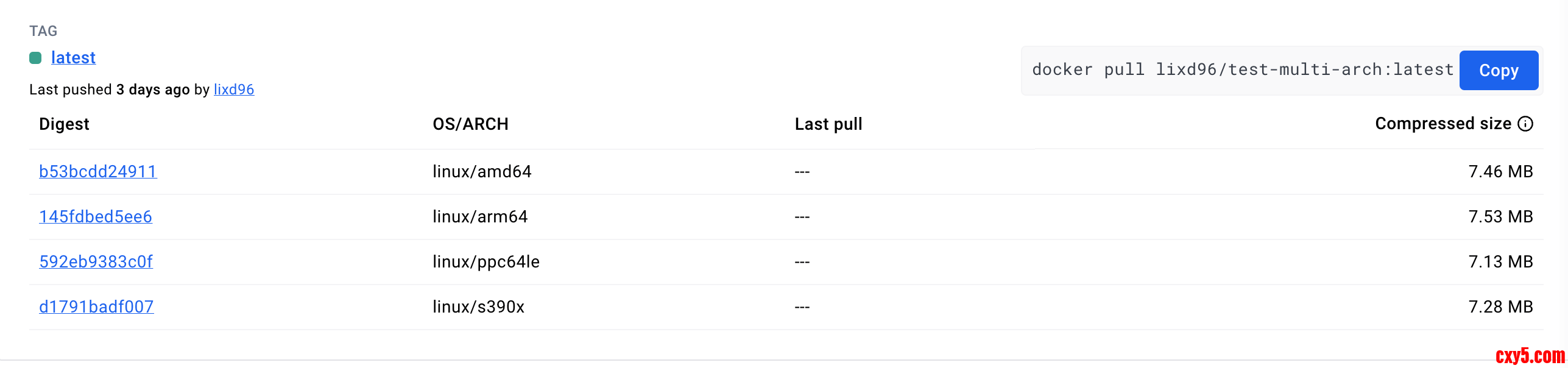
提交代码后,Workflow 会自动运行,到 Dockerhub 查看镜像是否成功推送:
可以看到,指定的 4 个架构都成功构建并推送过来了。
【Kubernetes 系列】持续更新中,搜索公众号【探索云原生】订阅,阅读更多文章。
6.小结
Buildah 提供了一种灵活且高效的镜像构建方式,无需 Docker 依赖,且支持 rootless 安全模式,适用于各种 DevOps 和 CI/CD 环境。它支持命令式和 Dockerfile 构建方式,还能进行多阶段构建和多架构镜像构建。
来源:程序园用户自行投稿发布,如果侵权,请联系站长删除
免责声明:如果侵犯了您的权益,请联系站长,我们会及时删除侵权内容,谢谢合作! |




 提升卡
提升卡 置顶卡
置顶卡 沉默卡
沉默卡 喧嚣卡
喧嚣卡 变色卡
变色卡 千斤顶
千斤顶 照妖镜
照妖镜