基于本地的ComfyUI API调用指南
ComfyUI作为文生图、文生视频、图生图、图生视频的各类模型的工作流都非常好用,可组合各种模型和Lora。但是想要通过API调用相对比较复杂,且无完善的文档。
本文阐述了ComfyUI API调用完整指南,涵盖工作流导出、API调用流程、参数说明及Python代码实现。
零、代码
不想看太多字,直接下载Demo查看示例即可
https://github.com/zer0Black/ComfyUI-Api-Demo
一、概述
ComfyUI提供了强大的API接口,允许开发者通过编程方式调用ComfyUI工作流,实现AI图像生成的自动化。通过API调用,可以批量生成图像、集成到现有系统中,大幅提升工作效率。
二、准备工作
2.1 搭建工作流
在ComfyUI WebUI中按照需求搭建工作流:
- 打开ComfyUI界面,拖拽所需的节点
- 连接节点之间的数据流
- 配置节点参数(模型、提示词、采样器等)
- 点击"Queue Prompt"测试工作流是否能正常生成图像
- 确认工作流运行无误后,准备导出
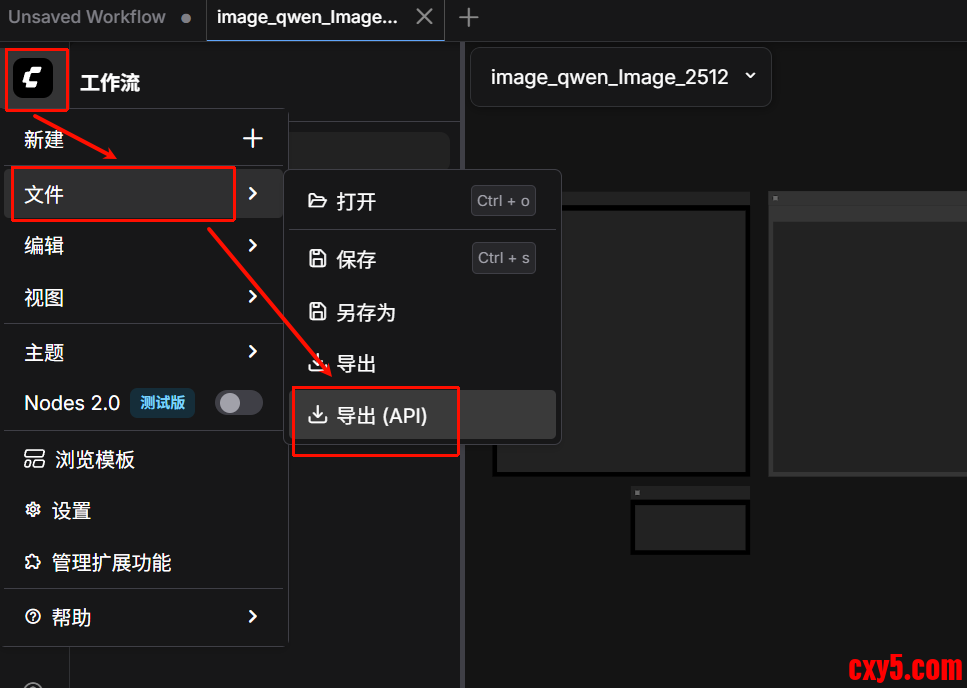
2.2 导出API格式的JSON文件
导出步骤:
- 在ComfyUI界面点击顶部菜单栏的工作流 (Workflow)
- 选择导出(API) (Export API)
- 浏览器会自动下载一个JSON文件,通常命名为workflow_api.json
重要提示: 导出的JSON文件包含了工作流的完整配置,包括所有节点的ID、参数和连接关系。这个文件是API调用的核心输入。
三、JSON文件详解
3.1 JSON文件结构
导出的workflow_api.json文件是一个字典,键为节点ID,值为节点配置:- {
- "60": {
- "inputs": {
- "filename_prefix": "Qwen-Image-2512",
- "images": [
- "86:8",
- 0
- ]
- },
- "class_type": "SaveImage",
- "_meta": {
- "title": "保存图像"
- }
- },
- "91": {
- "inputs": {
- "value": "提示词写在这"
- },
- "class_type": "PrimitiveStringMultiline",
- "_meta": {
- "title": "Prompt"
- }
- },
- "86:39": {
- "inputs": {
- "vae_name": "qwen_image_vae.safetensors"
- },
- "class_type": "VAELoader",
- "_meta": {
- "title": "加载VAE"
- }
- },
- "86:38": {
- "inputs": {
- "clip_name": "qwen_2.5_vl_7b_fp8_scaled.safetensors",
- "type": "qwen_image",
- "device": "default"
- },
- "class_type": "CLIPLoader",
- "_meta": {
- "title": "加载CLIP"
- }
- },
- "86:37": {
- "inputs": {
- "unet_name": "qwen_image_2512_fp8_e4m3fn.safetensors",
- "weight_dtype": "default"
- },
- "class_type": "UNETLoader",
- "_meta": {
- "title": "UNet加载器"
- }
- },
- "86:3": {
- "inputs": {
- "seed": 4,
- "steps": 50,
- "cfg": 4,
- "sampler_name": "euler",
- "scheduler": "simple",
- "denoise": 1,
- "model": [
- "86:66",
- 0
- ],
- "positive": [
- "86:81",
- 0
- ],
- "negative": [
- "86:7",
- 0
- ],
- "latent_image": [
- "86:58",
- 0
- ]
- },
- "class_type": "KSampler",
- "_meta": {
- "title": "K采样器"
- }
- },
- "86:58": {
- "inputs": {
- "width": 1664,
- "height": 928,
- "batch_size": 1
- },
- "class_type": "EmptySD3LatentImage",
- "_meta": {
- "title": "空Latent图像(SD3)"
- }
- },
- "86:81": {
- "inputs": {
- "text": [
- "91",
- 0
- ],
- "clip": [
- "86:38",
- 0
- ]
- },
- "class_type": "CLIPTextEncode",
- "_meta": {
- "title": "CLIP Text Encode (Positive Prompt)"
- }
- },
- "86:8": {
- "inputs": {
- "samples": [
- "86:3",
- 0
- ],
- "vae": [
- "86:39",
- 0
- ]
- },
- "class_type": "VAEDecode",
- "_meta": {
- "title": "VAE解码"
- }
- },
- "86:66": {
- "inputs": {
- "shift": 3.1000000000000005,
- "model": [
- "86:37",
- 0
- ]
- },
- "class_type": "ModelSamplingAuraFlow",
- "_meta": {
- "title": "采样算法(AuraFlow)"
- }
- },
- "86:7": {
- "inputs": {
- "text": "低分辨率,低画质,肢体畸形,手指畸形,画面过饱和,蜡像感,人脸无细节,过度光滑,画面具有AI感。构图混乱。文字模糊,扭曲",
- "clip": [
- "86:38",
- 0
- ]
- },
- "class_type": "CLIPTextEncode",
- "_meta": {
- "title": "CLIP Text Encode (Negative Prompt)"
- }
- }
- }
JSON文件是通过ComfyUI WebUI的"工作流 > 导出(API)"功能自动生成的,它准确反映了当前可视化工作流的状态。
3.3 需要修改的参数
通常情况下,你需要修改以下参数来实现动态调用:
节点类型参数名称说明修改建议KSamplerseed随机种子设置为-1可自动生成随机数,或每次请求指定不同的值KSamplersteps采样步数根据质量需求调整,通常20-50KSamplercfg提示词相关性通常7-12,数值越高越遵循提示词CLIPTextEncodetext提示词修改为你要生成的图像描述EmptyLatentImagewidth图像宽度根据需求调整(如512, 768, 1024)EmptyLatentImageheight图像高度根据需求调整CheckpointLoaderSimpleckpt_name模型文件名切换不同的基础模型修改示例:
由于每个工作流配置出的节点名称不一样,需要根据到处的json格式进行修改- # 加载原始JSON
- with open("workflow_api.json", "r", encoding="utf-8") as f:
- workflow = json.load(f)
- # 修改提示词
- workflow["91"]["inputs"]["text"] = "一只可爱的猫咪在花园里玩耍,高清摄影,8K"
- # 修改图像尺寸
- workflow["86:58"]["inputs"]["width"] = 1024
- workflow["86:58"]["inputs"]["height"] = 1024
- # 随机种子
- workflow["86:3"]["inputs"]["seed"] = -1
4.1 调用流程图
- 1. 搭建ComfyUI工作流
- ↓
- 2. 在WebUI中测试并确认工作正常
- ↓
- 3. 导出API格式JSON文件
- ↓
- 4. 在代码中加载JSON
- ↓
- 5. 修改需要动态调整的参数
- ↓
- 6. 发送POST请求到ComfyUI服务器
- ↓
- 7. 等待并接收生成结果
- ↓
- 8. 处理返回的图像数据
- 本地部署: 通常为 http://127.0.0.1:8188/api
- 云服务器: 替换为你的公网IP或域名
五、Python代码实现
5.1 基础同步调用
最简单的调用方式,直接等待结果返回:- import requests
- import json
- # ComfyUI服务器地址
- COMFYUI_ADDRESS = "http://127.0.0.1:8188/api"
- def generate_image_sync(prompt_text, width=512, height=512):
- """
- 同步调用ComfyUI API生成图像
- """
- # 1. 加载工作流JSON
- with open("workflow_api.json", "r", encoding="utf-8") as f:
- workflow = json.load(f)
- # 2. 修改参数
- workflow["91"]["inputs"]["text"] = prompt_text # 修改提示词
- workflow["86:58"]["inputs"]["width"] = width
- workflow["86:58"]["inputs"]["height"] = height
- workflow["86:3"]["inputs"]["seed"] = -1 # 随机种子
- # 3. 发送POST请求
- endpoint = f"{COMFYUI_ADDRESS}/prompt"
- response = requests.post(
- endpoint,
- json={"prompt": workflow},
- headers={"Content-Type": "application/json"}
- )
- # 4. 获取prompt_id
- result = response.json()
- prompt_id = result["prompt_id"]
- print(f"任务已提交,prompt_id: {prompt_id}")
- # 5. 等待生成完成
- history_endpoint = f"{COMFYUI_ADDRESS}/history/{prompt_id}"
- import time
- while True:
- history_response = requests.get(history_endpoint)
- history_data = history_response.json()
- if prompt_id in history_data:
- # 获取生成的图像
- outputs = history_data[prompt_id]["outputs"]
- for node_id, output_data in outputs.items():
- if "images" in output_data:
- for img in output_data["images"]:
- image_filename = img["filename"]
- print(f"图像已生成: {image_filename}")
- return {
- "prompt_id": prompt_id,
- "filename": image_filename,
- "full_path": f"{COMFYUI_ADDRESS}/view?filename={image_filename}"
- }
- break
- time.sleep(1)
- return None
- # 使用示例
- if __name__ == "__main__":
- result = generate_image_sync(
- prompt_text="一只可爱的猫咪在花园里玩耍,高清摄影,8K,细节丰富",
- width=768,
- height=768
- )
- print(result)
获取实时进度,适合需要显示生成过程的场景:5.3 批量生成图像
自动化批量生成多个图像:- import requests
- import json
- import time
- import concurrent.futures
- COMFYUI_ADDRESS = "http://127.0.0.1:8188"
- def generate_single_image(prompt_text, seed=None, width=512, height=512):
- """
- 生成单张图像
- """
- with open("workflow_api.json", "r", encoding="utf-8") as f:
- workflow = json.load(f)
- workflow["91"]["inputs"]["text"] = prompt_text # 修改提示词
- workflow["86:58"]["inputs"]["width"] = width
- workflow["86:58"]["inputs"]["height"] = height
- workflow["86:3"]["inputs"]["seed"] = -1 # 随机种子
-
- if seed is None:
- workflow["86:3"]["inputs"]["seed"] = -1 # 随机种子
- else:
- workflow["86:3"]["inputs"]["seed"] = seed
- endpoint = f"{COMFYUI_ADDRESS}/prompt"
- response = requests.post(
- endpoint,
- json={"prompt": workflow},
- headers={"Content-Type": "application/json"}
- )
- result = response.json()
- prompt_id = result["prompt_id"]
- # 等待完成
- while True:
- history_response = requests.get(f"{COMFYUI_ADDRESS}/history/{prompt_id}")
- history_data = history_response.json()
- if prompt_id in history_data:
- outputs = history_data[prompt_id]["outputs"]
- for node_id, output_data in outputs.items():
- if "images" in output_data:
- filename = output_data["images"][0]["filename"]
- return {
- "prompt": prompt_text,
- "seed": workflow["86:3"]["inputs"]["seed"],
- "filename": filename,
- "url": f"{COMFYUI_ADDRESS}/view?filename={filename}"
- }
- time.sleep(0.5)
- def batch_generate(prompts, max_workers=2):
- """
- 批量生成图像(并发)
- """
- results = []
- with concurrent.futures.ThreadPoolExecutor(max_workers=max_workers) as executor:
- future_to_prompt = {
- executor.submit(generate_single_image, prompt): prompt
- for prompt in prompts
- }
- for future in concurrent.futures.as_completed(future_to_prompt):
- prompt = future_to_prompt[future]
- try:
- result = future.result()
- results.append(result)
- print(f"✓ 完成: {prompt}")
- except Exception as e:
- print(f"✗ 失败: {prompt}, 错误: {e}")
- return results
- # 使用示例
- if __name__ == "__main__":
- prompts = [
- "一只可爱的猫咪在花园里玩耍",
- "美丽的日落风景,金色阳光",
- "高山湖泊,倒影清晰",
- "城市夜景,霓虹闪烁",
- "森林小径,阳光斑驳"
- ]
- print("开始批量生成...")
- results = batch_generate(prompts, max_workers=2)
- print(f"\n生成完成,共 {len(results)} 张图像:")
- for i, result in enumerate(results, 1):
- print(f"{i}. {result['prompt']}")
- print(f" 文件: {result['filename']}")
- print(f" 链接: {result['url']}\n")
将生成的图像保存到本地:- import requests
- import os
- def download_image(image_url, save_path, filename=None):
- """
- 下载生成的图像到本地
- """
- try:
- response = requests.get(image_url)
- response.raise_for_status()
- if filename is None:
- filename = image_url.split("filename=")[-1]
- full_path = os.path.join(save_path, filename)
- os.makedirs(save_path, exist_ok=True)
- with open(full_path, "wb") as f:
- f.write(response.content)
- print(f"图像已保存: {full_path}")
- return full_path
- except Exception as e:
- print(f"下载失败: {e}")
- return None
- # 使用示例
- if __name__ == "__main__":
- image_url = "http://127.0.0.1:8188/view?filename=ComfyUI_00001.png"
- save_path = "./generated_images"
- download_image(image_url, save_path)
6.1 请求参数
参数类型必填说明promptobject是工作流JSON对象client_idstring否客户端标识符,用于区分不同请求6.2 响应参数
参数类型说明prompt_idstring任务的唯一标识符numbernumber队列中排队的任务数node_errorsobject节点错误信息6.3 常见HTTP状态码
状态码说明200请求成功400请求参数错误500服务器内部错误七、常见问题
Q1: 提示词不生效怎么办?
检查节点ID是否正确。导出的JSON中,CLIPTextEncode节点的ID可能与你的不同,需要根据实际JSON调整。
Q2: 如何获取生成的图像文件?
方法1: 通过/view端点直接访问- image_url = f"{COMFYUI_ADDRESS}/view?filename={filename}"
Q3: 批量生成速度慢怎么办?
- 使用多线程并发请求
- 优化工作流,减少不必要的节点
- 使用更强大的GPU
- 考虑使用云平台的Serverless API,支持多实例并发
Q4: API调用返回错误?
检查:
- ComfyUI服务器是否正常运行
- 工作流JSON格式是否正确
- 节点连接关系是否完整
- 模型文件是否存在
八、进阶技巧
8.1 动态替换模型
- def change_model(workflow, model_name):
- """
- 切换模型
- """
- # 假设节点4是CheckpointLoaderSimple
- workflow["4"]["inputs"]["ckpt_name"] = model_name
- return workflow
- # 使用
- workflow = change_model(workflow, "sd_xl_base_1.0.safetensors")
导出的JSON如果包含ControlNet,需要确保ControlNet模型已加载:- # ControlNet预处理器节点通常需要额外的参数
- workflow["controlnet_node"]["inputs"]["image"] = ["load_image_node", 0]
- # 在KSampler之前添加Lora加载节点
- # 修改model的连接,从CheckpointLoader改为LoraLoader
- workflow["3"]["inputs"]["model"] = ["lora_loader_node", 0]
通过ComfyUI API,我们可以实现:
- ✓ 工作流自动化执行
- ✓ 批量图像生成
- ✓ 集成到现有系统
- ✓ 实时进度监控
- ✓ 云端部署和扩展
关键步骤:
- 在ComfyUI WebUI中搭建并测试工作流
- 导出API格式JSON文件
- 在代码中加载JSON并修改参数
- 通过HTTP/WebSocket发送请求
- 处理返回结果
来源:程序园用户自行投稿发布,如果侵权,请联系站长删除
免责声明:如果侵犯了您的权益,请联系站长,我们会及时删除侵权内容,谢谢合作! |


 提升卡
提升卡 置顶卡
置顶卡 沉默卡
沉默卡 喧嚣卡
喧嚣卡 变色卡
变色卡 千斤顶
千斤顶 照妖镜
照妖镜