今天来梳理一下 Flink 双流操作相关的源码。
写在前面
通过Flink学习笔记:多流 Join一文的介绍,我们知道 Flink 有三种数据关联的方式,分别是 Window Join、Interval Join 和 CoGroup。下面我们分别看下这三种关联方式的源码实现。
Window Join
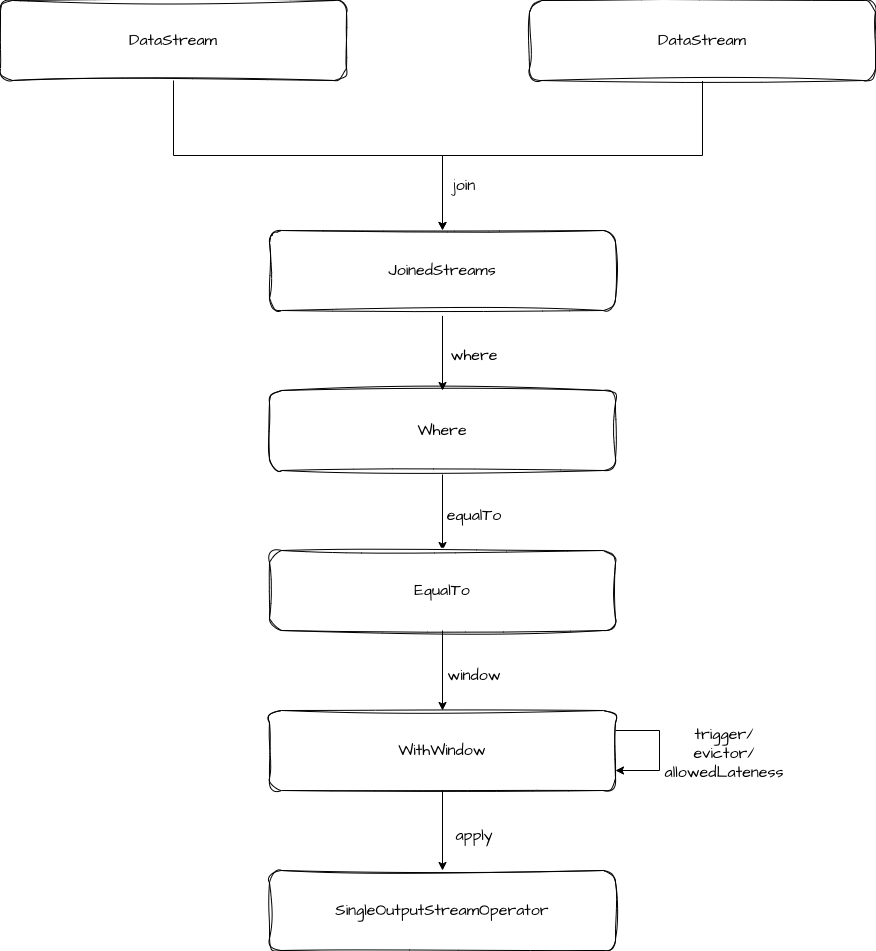
我们先回顾一下 window join 的使用方法。- DataStream result = source1.join(source2) .where(record -> record.f0) .equalTo(record -> record.f0) .window(TumblingEventTimeWindows.of(Time.seconds(2L))) .apply(new JoinFunction() { @Override public Tuple2 join(Tuple2 record1, Tuple2 record2) throws Exception { return Tuple2.of(record1.f0, record1.f1); } });
在 WithWindow 的 apply 方法中,是构建了一个 coGroupedWindowedStream,然后调用它的 apply 方法。- public SingleOutputStreamOperator apply( JoinFunction function, TypeInformation resultType) { // clean the closure function = input1.getExecutionEnvironment().clean(function); coGroupedWindowedStream = input1.coGroup(input2) .where(keySelector1) .equalTo(keySelector2) .window(windowAssigner) .trigger(trigger) .evictor(evictor) .allowedLateness(allowedLateness); return coGroupedWindowedStream.apply(new JoinCoGroupFunction(function), resultType);}
在 JoinCoGroupFunction 中,coGroup 方法就是对两个流进行两层遍历,然后将其应用到我们自定义的 JoinFunction 上。- private static class JoinCoGroupFunction extends WrappingFunction implements CoGroupFunction { private static final long serialVersionUID = 1L; public JoinCoGroupFunction(JoinFunction wrappedFunction) { super(wrappedFunction); } @Override public void coGroup(Iterable first, Iterable second, Collector out) throws Exception { for (T1 val1 : first) { for (T2 val2 : second) { out.collect(wrappedFunction.join(val1, val2)); } } }}
CoGroup 的整体用法和流程与 Join 都类似,我们就不逐个介绍了。我们直接来看 apply 方法。- public SingleOutputStreamOperator apply( CoGroupFunction function, TypeInformation resultType) { // clean the closure function = input1.getExecutionEnvironment().clean(function); UnionTypeInfo unionType = new UnionTypeInfo(input1.getType(), input2.getType()); UnionKeySelector unionKeySelector = new UnionKeySelector(keySelector1, keySelector2); SingleOutputStreamOperator taggedInput1 = input1.map(new Input1Tagger()); taggedInput1.getTransformation().setParallelism(input1.getParallelism(), false); taggedInput1.returns(unionType); SingleOutputStreamOperator taggedInput2 = input2.map(new Input2Tagger()); taggedInput2.getTransformation().setParallelism(input2.getParallelism(), false); taggedInput2.returns(unionType); DataStream unionStream = taggedInput1.union(taggedInput2); // we explicitly create the keyed stream to manually pass the key type information in windowedStream = new KeyedStream( unionStream, unionKeySelector, keyType) .window(windowAssigner); if (trigger != null) { windowedStream.trigger(trigger); } if (evictor != null) { windowedStream.evictor(evictor); } if (allowedLateness != null) { windowedStream.allowedLateness(allowedLateness); } return windowedStream.apply( new CoGroupWindowFunction(function), resultType);}
在调用 windowedStream.apply 方法时,又将 function 包装成了 CoGroupWindowFunction。- private static class CoGroupWindowFunction extends WrappingFunction implements WindowFunction { private static final long serialVersionUID = 1L; public CoGroupWindowFunction(CoGroupFunction userFunction) { super(userFunction); } @Override public void apply(KEY key, W window, Iterable values, Collector out) throws Exception { List oneValues = new ArrayList(); List twoValues = new ArrayList(); for (TaggedUnion val : values) { if (val.isOne()) { oneValues.add(val.getOne()); } else { twoValues.add(val.getTwo()); } } wrappedFunction.coGroup(oneValues, twoValues, out); }}
Interval Join
梳理完了 Window Join 和 CoGroup 之后,我们再接着看 Interval Join。还是先来回顾一下用法。- DataStream intervalJoinResult = source1.keyBy(record -> record.f0) .intervalJoin(source2.keyBy(record -> record.f0)) .between(Time.seconds(-2), Time.seconds(2)) .process(new ProcessJoinFunction() { @Override public void processElement(Tuple2 record1, Tuple2 record2, ProcessJoinFunction.Context context, Collector out) throws Exception { out.collect(Tuple2.of(record1.f0, record1.f1 + record2.f1)); } });
在调用过程中,类型的转换如下图。
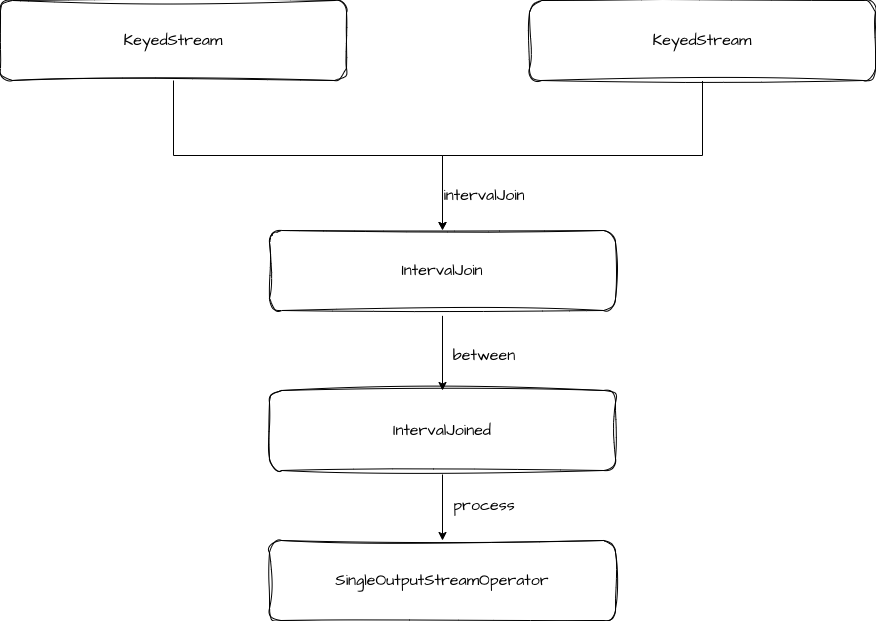
我们主要关注 process 的逻辑。- public SingleOutputStreamOperator process( ProcessJoinFunction processJoinFunction, TypeInformation outputType) { Preconditions.checkNotNull(processJoinFunction); Preconditions.checkNotNull(outputType); final ProcessJoinFunction cleanedUdf = left.getExecutionEnvironment().clean(processJoinFunction); if (isEnableAsyncState) { final AsyncIntervalJoinOperator operator = new AsyncIntervalJoinOperator( lowerBound, upperBound, lowerBoundInclusive, upperBoundInclusive, leftLateDataOutputTag, rightLateDataOutputTag, left.getType() .createSerializer( left.getExecutionConfig().getSerializerConfig()), right.getType() .createSerializer( right.getExecutionConfig().getSerializerConfig()), cleanedUdf); return left.connect(right) .keyBy(keySelector1, keySelector2) .transform("Interval Join [Async]", outputType, operator); } else { final IntervalJoinOperator operator = new IntervalJoinOperator( lowerBound, upperBound, lowerBoundInclusive, upperBoundInclusive, leftLateDataOutputTag, rightLateDataOutputTag, left.getType() .createSerializer( left.getExecutionConfig().getSerializerConfig()), right.getType() .createSerializer( right.getExecutionConfig().getSerializerConfig()), cleanedUdf); return left.connect(right) .keyBy(keySelector1, keySelector2) .transform("Interval Join", outputType, operator); }}
具体的 Operator 是 IntervalJoinOperator 或 AsyncIntervalJoinOperator,它们都是 TwoInputStreamOperator 的实现类,提供 processElement1 和 processElement2 两个方法分别处理两个输入源的数据,最终都调用的是 processElement。- private void processElement( final StreamRecord record, final MapState ourBuffer, final MapState otherBuffer, final long relativeLowerBound, final long relativeUpperBound, final boolean isLeft) throws Exception { final THIS ourValue = record.getValue(); final long ourTimestamp = record.getTimestamp(); if (ourTimestamp == Long.MIN_VALUE) { throw new FlinkException( "Long.MIN_VALUE timestamp: Elements used in " + "interval stream joins need to have timestamps meaningful timestamps."); } if (isLate(ourTimestamp)) { sideOutput(ourValue, ourTimestamp, isLeft); return; } addToBuffer(ourBuffer, ourValue, ourTimestamp); for (Map.Entry bucket : otherBuffer.entries()) { final long timestamp = bucket.getKey(); if (timestamp < ourTimestamp + relativeLowerBound || timestamp > ourTimestamp + relativeUpperBound) { continue; } for (BufferEntry entry : bucket.getValue()) { if (isLeft) { collect((T1) ourValue, (T2) entry.element, ourTimestamp, timestamp); } else { collect((T1) entry.element, (T2) ourValue, timestamp, ourTimestamp); } } } long cleanupTime = (relativeUpperBound > 0L) ? ourTimestamp + relativeUpperBound : ourTimestamp; if (isLeft) { internalTimerService.registerEventTimeTimer(CLEANUP_NAMESPACE_LEFT, cleanupTime); } else { internalTimerService.registerEventTimeTimer(CLEANUP_NAMESPACE_RIGHT, cleanupTime); }}
总结
本文我们梳理了 Flink 的三种双流操作的源码,我们了解到 Window Join 底层是通过 CoGroup 实现的。CoGroup 本身是将两个流合并成 WindowedStream 并依赖于 WindowState 进行数据 join。最后 Interval Join 是通过 ConnectedStreams 实现的,内部的 IntervalJoinOperator 会维护两个 MapState,通过 MapState 进行数据关联。
来源:程序园用户自行投稿发布,如果侵权,请联系站长删除
免责声明:如果侵犯了您的权益,请联系站长,我们会及时删除侵权内容,谢谢合作! |


 提升卡
提升卡 置顶卡
置顶卡 沉默卡
沉默卡 喧嚣卡
喧嚣卡 变色卡
变色卡 千斤顶
千斤顶 照妖镜
照妖镜