原文 | Luis, Adam
翻译 | 郑子铭
丰富和处理您的数据
下一步是处理数据IngestionChunk块。数据块处理器在数据块级别进行操作,可以丰富内容或执行其他转换。与文档处理器类似,选择使用哪些处理器取决于您的具体应用场景。
此示例使用内置功能SummaryEnricher,通过 AI 服务为每个数据块添加摘要:- IngestionChunkProcessor<string> summaryEnricher = new SummaryEnricher(enricherOptions);
存储已处理的数据块是数据摄取管道的最后一步。s是一个用于将数据块存储在任何存储中的IngestionChunkWriter抽象概念,但它是一个使用向量存储的实现。它构建于 Microsoft.Extensions.VectorData.Abstractions抽象之上,因此您可以使用任何受支持的向量存储。IngestionChunkVectorStoreWriter
在这个例子中,我们将使用 SQLiteSqliteVectorStore将数据块存储在本地 SQLite 数据库中:- using SqliteVectorStore vectorStore = new(
- "Data Source=vectors.db;Pooling=false",
- new()
- {
- EmbeddingGenerator = embeddingGenerator
- });
- // The writer requires the embedding dimension count to be specified.
- // For OpenAI's `text-embedding-3-small`, the dimension count is 1536.
- using VectorStoreWriter<string> writer = new(vectorStore, dimensionCount: 1536);
- 使用默认架构创建向量存储集合。
- 使用提供的嵌入生成器为每个数据块生成嵌入。
- 完成后,删除之前为具有相同 ID 的文档存储的所有数据块(以支持对同一文档的不同版本进行增量分块)。
编写并运行您的管道
使用IngestionPipeline先前配置的读取器、分块器、增强器和写入器来处理当前目录中的所有文件。- using IngestionPipeline<string> pipeline = new(reader, chunker, writer, loggerFactory: loggerFactory)
- {
- DocumentProcessors = { imageAlternativeTextEnricher },
- ChunkProcessors = { summaryEnricher }
- };
- await foreach (var result in pipeline.ProcessAsync(new DirectoryInfo("."), searchPattern: "*.md"))
- {
- Console.WriteLine($"Completed processing '{result.DocumentId}'. Succeeded: '{result.Succeeded}'.");
- }
单个文档导入失败不应导致整个流程失败。该机制IngestionPipeline.ProcessAsync通过返回部分成功来实现IAsyncEnumerable。调用者负责处理任何失败情况(例如,重试导入失败的文档或在遇到第一个错误时停止)。
检索数据
VectorStoreWriter公开了可用于对存储的数据块执行向量搜索的底层机制VectorStoreCollection。此示例提示用户输入查询,并从向量存储中返回最相似的 3 个数据块:- var collection = writer.VectorStoreCollection;
- while (true)
- {
- Console.Write("Enter your question (or 'exit' to quit): ");
- string? searchValue = Console.ReadLine();
- if (string.IsNullOrEmpty(searchValue) || searchValue == "exit")
- {
- break;
- }
- Console.WriteLine("Searching...\n");
- await foreach (var result in collection.SearchAsync(searchValue, top: 3))
- {
- Console.WriteLine($"Score: {result.Score}\n\tContent: {result.Record["content"]}");
- }
- }
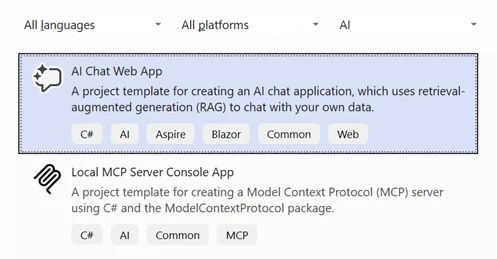
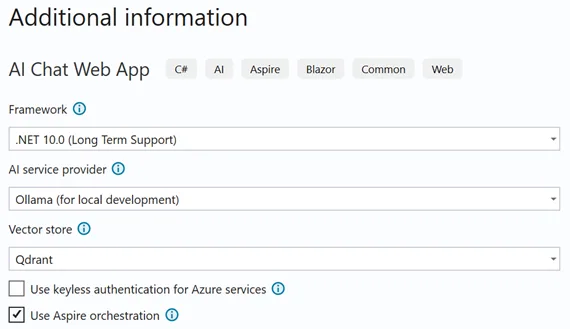
想看看实际效果吗?试试全新的 .NET AI Web 聊天模板,体验完整的端到端流程。您可以使用MarkItDown MCP 服务器解析文档,使用语义感知分块器将其分块,并将分块存储在您选择的矢量数据库中。示例应用程序包含一个 Web 聊天功能,该功能使用已接收的数据进行 RAG(红绿灯)分析。- dotnet new install Microsoft.Extensions.AI.Templates
构建您的分布式应用程序
以下来自模板的代码片段展示了如何在 Aspire 中配置应用程序的不同组件,包括用于托管模型的 Ollama、用于矢量存储的 Qdrant、用于文档解析的 MarkItDown 以及 Web 应用程序本身。- var builder = DistributedApplication.CreateBuilder(args);
- var ollama = builder.AddOllama("ollama")
- .WithDataVolume();
- var chat = ollama.AddModel("chat", "llama3.2");
- var embeddings = ollama.AddModel("embeddings", "all-minilm");
- var vectorDB = builder.AddQdrant("vectordb")
- .WithDataVolume()
- .WithLifetime(ContainerLifetime.Persistent);
- var markitdown = builder.AddContainer("markitdown", "mcp/markitdown")
- .WithArgs("--http", "--host", "0.0.0.0", "--port", "3001")
- .WithHttpEndpoint(targetPort: 3001, name: "http");
- var webApp = builder.AddProject<Projects.RagSample_Web>("aichatweb-app");
- webApp
- .WithReference(chat)
- .WithReference(embeddings)
- .WaitFor(chat)
- .WaitFor(embeddings);
- webApp
- .WithReference(vectorDB)
- .WaitFor(vectorDB);
- webApp
- .WithEnvironment("MARKITDOWN_MCP_URL", markitdown.GetEndpoint("http"));
- builder.Build().Run();
可观测性
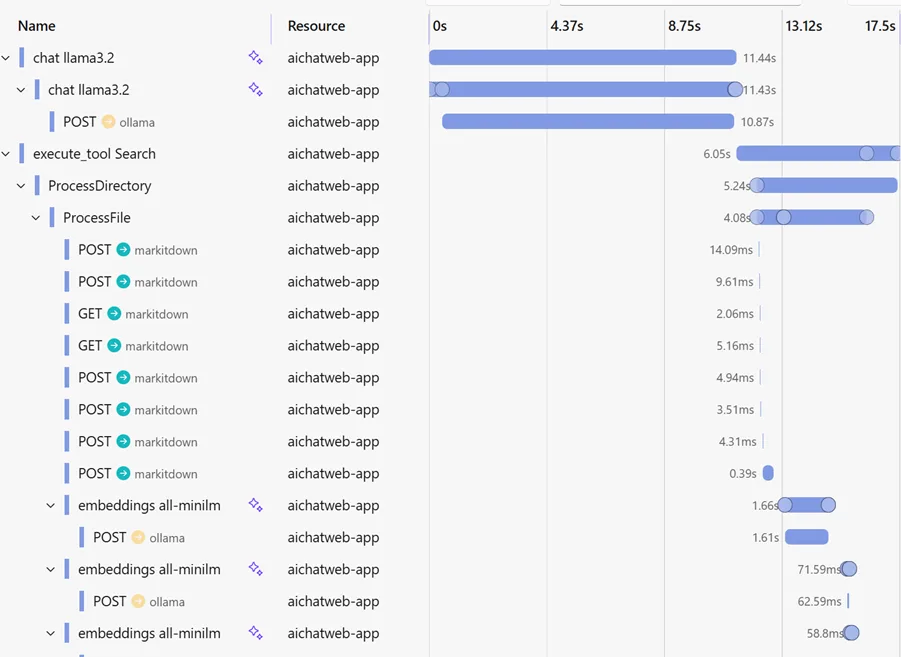
使用Aspire,您可以获得丰富的数据摄取管道可观测性体验。
该模板已经包含了对数据摄取过程和 Web 应用程序的OpenTelemetry 跟踪。- public static TBuilder ConfigureOpenTelemetry<TBuilder>(this TBuilder builder) where TBuilder : IHostApplicationBuilder
- {
- // The rest is omitted for brevity.
- builder.Services.AddOpenTelemetry()
- .WithTracing(tracing =>
- {
- tracing
- .AddSource("Experimental.Microsoft.Extensions.AI")
- .AddSource("Experimental.Microsoft.Extensions.DataIngestion");
- });
- return builder;
- }
准备好开始了吗?
最简单的入门方法是安装 AI 网络聊天模板。
安装 AI 网络聊天模板
熟悉模板后,尝试将其用于您自己的文件。
如果您是库作者或生态系统开发者,您可以扩展抽象,使您的用户能够无缝地互操作和组合来自各种提供商的读取器、分块器、处理器和写入器。
请提交您的问题、疑虑和建议,以帮助我们塑造这些构建模块的未来。
原文链接
Introducing Data Ingestion Building Blocks (Preview)
本作品采用知识共享署名-非商业性使用-相同方式共享 4.0 国际许可协议进行许可。
欢迎转载、使用、重新发布,但务必保留文章署名 郑子铭 (包含链接: http://www.cnblogs.com/MingsonZheng/ ),不得用于商业目的,基于本文修改后的作品务必以相同的许可发布。
如有任何疑问,请与我联系 (MingsonZheng@outlook.com)
来源:程序园用户自行投稿发布,如果侵权,请联系站长删除
免责声明:如果侵犯了您的权益,请联系站长,我们会及时删除侵权内容,谢谢合作! |




 提升卡
提升卡 置顶卡
置顶卡 沉默卡
沉默卡 喧嚣卡
喧嚣卡 变色卡
变色卡 千斤顶
千斤顶 照妖镜
照妖镜