前文我们介绍了 Flink 的四种执行图,并且通过源码了解了 Flink 的 StreamGraph 是怎么生成的,本文我们就一起来看下 Flink 的另一种执行图——JobGraph 是如何生成的。
StreamGraph 和 JobGraph 的区别
在正式开始之前,我们再来回顾一下 StreamGraph 和 JobGraph 的区别。假设我们的任务是建造一座大楼,StreamGraph 就像是设计蓝图,它描述了每个窗户、每根水管的位置和规格,而 JobGraph 像是给到施工队的施工流程图,它描述了每个任务模块,例如先把地基浇筑好,再铺设管线等。总的来说,JobGraph 更偏向执行层面,它是由 StreamGraph 优化而来。
回到 Flink 本身,我们通过一个表格来了解两个图的区别。
StreamGraph JobGraph 生成阶段 客户端,执行 execute() 时 客户端,提交前由 StreamGraph 转换生成 抽象层级 高层逻辑图,直接对应 API 优化后的执行图,为调度做准备 核心优化 无 主要是算子链优化 节点 StreamNode JobVertex 边 StreamEdge JobEdge 提交对象 无 提交给 JobManager 包含资源 无 包含执行作业所需的 Jar 包、依赖库和资源文件 JobVertex
JobGraph 中的节点是 JobVertex,在 StreamGraph 转换成 JobGraph 的过程中,会将多个节点串联起来,最终生成 JobVertex。
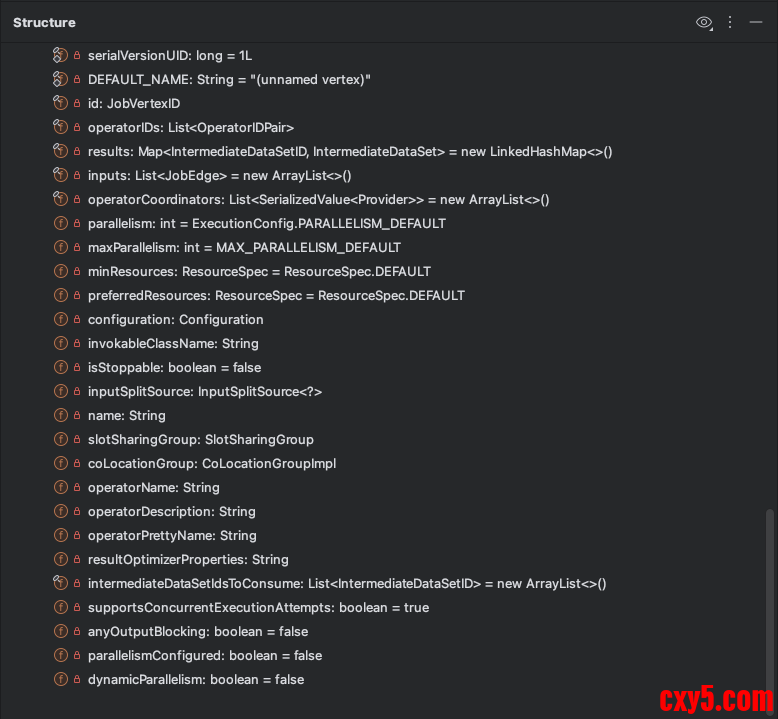
JobVertex包含以下成员变量:
我们分别看一下这些成员变量及其作用。
1、标识符相关
- // JobVertex的id,在作业执行过程中的唯一标识。监控、调度和故障恢复都会使用
- private final JobVertexID id;
- // operator id列表,按照深度优先顺序存储。operator 的管理、状态分配都会用到
- private final List<OperatorIDPair> operatorIDs;
- // 定义所有的输入边
- private final List<JobEdge> inputs = new ArrayList<>();
- // 定义所有的输出数据集
- private final Map<IntermediateDataSetID, IntermediateDataSet> results = new LinkedHashMap<>();
- // 输入分片源,主要用于批处理作业,定义如何将数据分成多个片
- private InputSplitSource<?> inputSplitSource;
- // 并行度,即运行时拆分子任务数量,默认使用全局配置
- private int parallelism = ExecutionConfig.PARALLELISM_DEFAULT;
- // 最大并行度
- private int maxParallelism = MAX_PARALLELISM_DEFAULT;
- // 存储运行时实际执行的类,使 Flink 可以灵活处理不同类型的操作符
- // 流任务可以是"org.apache.flink.streaming.runtime.tasks.StreamTask"
- // 批任务可以是"org.apache.flink.runtime.operators.BatchTask"
- private String invokableClassName;
- // 自定义配置
- private Configuration configuration;
- // 是否是动态设置并发度
- private boolean dynamicParallelism = false;
- // 是否支持优雅停止
- private boolean isStoppable = false;
- // JobVertex 最小资源需求
- private ResourceSpec minResources = ResourceSpec.DEFAULT;
- // JobVertex 推荐资源需求
- private ResourceSpec preferredResources = ResourceSpec.DEFAULT;
- // 用于资源优化,运行不同的 JobVertex 的子任务运行在同一个 slot
- @Nullable private SlotSharingGroup slotSharingGroup;
- // 需要严格共址的 JobVertex 组,每个 JobVertex 的第 n 个子任务运行在同一个 TaskManager
- @Nullable private CoLocationGroupImpl coLocationGroup;
- // 操作符协调器,用于处理全局协调逻辑
- private final List<SerializedValue<OperatorCoordinator.Provider>> operatorCoordinators =
- new ArrayList<>();
- // JobVertex 的名称
- private String name;
- // 操作符名称,比如 'Flat Map' 或 'Join'
- private String operatorName;
- // 操作符的描述,比如 'Hash Join' 或 'Sorted Group Reduce'
- private String operatorDescription;
- // 提供比 name 更友好的描述信息
- private String operatorPrettyName;
- // 是否支持同一个子任务并发多次执行
- private boolean supportsConcurrentExecutionAttempts = true;
- // 标记并发度是否被显式设置
- private boolean parallelismConfigured = false;
- // 是否有阻塞型输出
- private boolean anyOutputBlocking = false;
- // 存储该 JobVertex 需要消费的缓存中间数据集的 ID,可提高作业执行效率
- private final List<IntermediateDataSetID> intermediateDataSetIdsToConsume = new ArrayList<>();
在 StreamGraph 中,StreamEdge 是连接 StreamNode 的桥梁。在 JobGraph 中,与之对应的是 JobEdge,不同点在于 JobEdge 中保存的是输入节点和输出结果。
1、连接关系成员
- // 定义数据流向哪个 JobVertex
- private final JobVertex target;
- // 定义这条边的源数据
- private final IntermediateDataSet source;
- // 输入类型的编号
- private final int typeNumber;
- // 多个输入间的键是否相关,如果为 true,相同键的数据在一个输入被分割时,在其他数据对应的记录也会发送到相同的下游节点
- private final boolean interInputsKeysCorrelated;
- // 同一输入内相同的键是否必须发送到同一下游任务
- private final boolean intraInputKeyCorrelated;
- // 定义数据在并行任务期间的分发模式
- // 可能值:
- // ALL_TO_ALL:全连接,每个上游子任务连接所有下游任务
- // POINTWISE:点对点连接,一对一或一对多的本地连接
- private final DistributionPattern distributionPattern;
- // 是否为广播连接
- private final boolean isBroadcast;
- // 是否为 forward 连接,forward 连接最高效,直接转发,无需序列化网络传输
- private final boolean isForward;
- // 数据传输策略名称,用于显示
- private String shipStrategyName;
- // 下游状态重分布映射器,当作业扩容时,决定是否重新分配下游算子的持久化状态
- private SubtaskStateMapper downstreamSubtaskStateMapper = SubtaskStateMapper.ROUND_ROBIN;
- // 上游状态重分布映射器,当作业扩容时,决定是否重新分配上游算子的持久化状态
- private SubtaskStateMapper upstreamSubtaskStateMapper = SubtaskStateMapper.ROUND_ROBIN;
- // 预处理操作的名称
- private String preProcessingOperationName;
- // 操作符级别缓存的描述
- private String operatorLevelCachingDescription;
现在我们再来看一下 StreamGraph 是如何转换成 JobGraph 的。转换逻辑的入口是 StreamGraph.getJobGraph 方法。它只是调用了 StreamingJobGraphGenerator.createJobGraph,核心逻辑在 createJobGraph 方法中。
- private JobGraph createJobGraph() {
- // 预验证,检查 StreamGraph 配置正确性
- preValidate(streamGraph, userClassloader);
- // 【核心】链化操作符
- setChaining();
- if (jobGraph.isDynamic()) {
- // 支持动态扩缩容场景,为动态图设置并行度
- setVertexParallelismsForDynamicGraphIfNecessary();
- }
- // Note that we set all the non-chainable outputs configuration here because the
- // "setVertexParallelismsForDynamicGraphIfNecessary" may affect the parallelism of job
- // vertices and partition-reuse
- final Map<Integer, Map<StreamEdge, NonChainedOutput>> opIntermediateOutputs =
- new HashMap<>();
- // 设置不能链化的输出边
- setAllOperatorNonChainedOutputsConfigs(opIntermediateOutputs, jobVertexBuildContext);
- setAllVertexNonChainedOutputsConfigs(opIntermediateOutputs);
- // 设置物理边连接
- setPhysicalEdges(jobVertexBuildContext);
- // 设置支持并发执行的 JobVertex
- markSupportingConcurrentExecutionAttempts(jobVertexBuildContext);
- // 验证混合 shuffle 模式只在批处理模式下使用
- validateHybridShuffleExecuteInBatchMode(jobVertexBuildContext);
- // 设置 Slot 共享和协同定位
- setSlotSharingAndCoLocation(jobVertexBuildContext);
- // 设置托管内存比例
- setManagedMemoryFraction(jobVertexBuildContext);
- // 为 JobVertex 名称添加前缀
- addVertexIndexPrefixInVertexName(jobVertexBuildContext, new AtomicInteger(0));
- // 设置操作符描述信息
- setVertexDescription(jobVertexBuildContext);
- // Wait for the serialization of operator coordinators and stream config.
- // 序列化操作符协调器和流配置
- serializeOperatorCoordinatorsAndStreamConfig(serializationExecutor, jobVertexBuildContext);
- return jobGraph;
- }
- private void setChaining() {
- // we separate out the sources that run as inputs to another operator (chained inputs)
- // from the sources that needs to run as the main (head) operator.
- final Map<Integer, OperatorChainInfo> chainEntryPoints =
- buildChainedInputsAndGetHeadInputs();
- final Collection<OperatorChainInfo> initialEntryPoints =
- chainEntryPoints.entrySet().stream()
- .sorted(Comparator.comparing(Map.Entry::getKey))
- .map(Map.Entry::getValue)
- .collect(Collectors.toList());
- // iterate over a copy of the values, because this map gets concurrently modified
- for (OperatorChainInfo info : initialEntryPoints) {
- createChain(
- info.getStartNodeId(),
- 1, // operators start at position 1 because 0 is for chained source inputs
- info,
- chainEntryPoints,
- true,
- serializationExecutor,
- jobVertexBuildContext,
- null);
- }
- }
- public static boolean isChainableSource(StreamNode streamNode, StreamGraph streamGraph) {
- // 最基本的一些判空,输出边数量为1
- if (streamNode.getOperatorFactory() == null
- || !(streamNode.getOperatorFactory() instanceof SourceOperatorFactory)
- || streamNode.getOutEdges().size() != 1) {
- return false;
- }
- final StreamEdge sourceOutEdge = streamNode.getOutEdges().get(0);
- final StreamNode target = streamGraph.getStreamNode(sourceOutEdge.getTargetId());
- final ChainingStrategy targetChainingStrategy =
- Preconditions.checkNotNull(target.getOperatorFactory()).getChainingStrategy();
- // 链化策略必须 HEAD_WITH_SOURCES,输出边是可链化的
- return targetChainingStrategy == ChainingStrategy.HEAD_WITH_SOURCES
- && isChainableInput(sourceOutEdge, streamGraph, false);
- }
- private static boolean isChainableInput(
- StreamEdge edge, StreamGraph streamGraph, boolean allowChainWithDefaultParallelism) {
- StreamNode upStreamVertex = streamGraph.getSourceVertex(edge);
- StreamNode downStreamVertex = streamGraph.getTargetVertex(edge);
- if (!(streamGraph.isChainingEnabled()
- // 上下游节点是否在同一个 slot 共享组
- && upStreamVertex.isSameSlotSharingGroup(downStreamVertex)
- // 操作符是否可以链化,主要做并行度检查
- && areOperatorsChainable(
- upStreamVertex,
- downStreamVertex,
- streamGraph,
- allowChainWithDefaultParallelism)
- // 分区器和交换模式是否支持链化
- && arePartitionerAndExchangeModeChainable(
- edge.getPartitioner(), edge.getExchangeMode(), streamGraph.isDynamic()))) {
- return false;
- }
- // check that we do not have a union operation, because unions currently only work
- // through the network/byte-channel stack.
- // we check that by testing that each "type" (which means input position) is used only once
- // 检查是否为 Union 操作,Union 操作不能链化
- for (StreamEdge inEdge : downStreamVertex.getInEdges()) {
- if (inEdge != edge && inEdge.getTypeNumber() == edge.getTypeNumber()) {
- return false;
- }
- }
- return true;
- }
- Source(并行度=4) -> Map(并行度=4) -> Filter(并行度=4)
- Source -> Map 边:
- 1. isChainingEnabled() = true
- 2. isSameSlotSharingGroup() = true (都在默认组)
- 3. areOperatorsChainable() = true (Source可链化,Map是HEAD_WITH_SOURCES)
- 4. arePartitionerAndExchangeModeChainable() = true (ForwardPartitioner)
- 5. Union检查通过
- 结果:可链化
- Map -> Filter 边:
- 1. isChainingEnabled() = true
- 2. isSameSlotSharingGroup() = true
- 3. areOperatorsChainable() = true (Map和Filter都是ALWAYS)
- 4. arePartitionerAndExchangeModeChainable() = true (ForwardPartitioner)
- 5. Union检查通过
- 结果:可链化
- 最终:Source -> Map -> Filter 三者链化到一个JobVertex中
- Source(并行度=2) -> Map(并行度=4) // 并行度不匹配
- Source -> Map 边:
- 1. isChainingEnabled() = true
- 2. isSameSlotSharingGroup() = true
- 3. areOperatorsChainable() = false (并行度不匹配)
- 结果:不可链化,需要网络传输
- Source1 --\
- Union -> Map
- Source2 --/
- Source1 -> Union 边:
- 虽然满足前4个条件,但Union节点有两个输入边,typeNumber相同
- Union检查失败,不可链化
- public static List<StreamEdge> createChain(
- final Integer currentNodeId,
- final int chainIndex,
- final OperatorChainInfo chainInfo,
- final Map<Integer, OperatorChainInfo> chainEntryPoints,
- final boolean canCreateNewChain,
- final Executor serializationExecutor,
- final JobVertexBuildContext jobVertexBuildContext,
- final @Nullable Consumer<Integer> visitedStreamNodeConsumer) {
- ......
- // 拆分可链化边和不可链化边
- for (StreamEdge outEdge : currentNode.getOutEdges()) {
- if (isChainable(outEdge, streamGraph)) {
- chainableOutputs.add(outEdge);
- } else {
- nonChainableOutputs.add(outEdge);
- }
- }
- // 处理可链化边
- for (StreamEdge chainable : chainableOutputs) {
- StreamNode targetNode = streamGraph.getStreamNode(chainable.getTargetId());
- Attribute targetNodeAttribute = targetNode.getAttribute();
- if (isNoOutputUntilEndOfInput) {
- if (targetNodeAttribute != null) {
- targetNodeAttribute.setNoOutputUntilEndOfInput(true);
- }
- }
- transitiveOutEdges.addAll(
- createChain(
- chainable.getTargetId(),
- chainIndex + 1,
- chainInfo,
- chainEntryPoints,
- canCreateNewChain,
- serializationExecutor,
- jobVertexBuildContext,
- visitedStreamNodeConsumer));
- // Mark upstream nodes in the same chain as outputBlocking
- if (targetNodeAttribute != null
- && targetNodeAttribute.isNoOutputUntilEndOfInput()) {
- currentNodeAttribute.setNoOutputUntilEndOfInput(true);
- }
- }
- // 处理不可链化边
- for (StreamEdge nonChainable : nonChainableOutputs) {
- transitiveOutEdges.add(nonChainable);
- // Used to control whether a new chain can be created, this value is true in the
- // full graph generation algorithm and false in the progressive generation
- // algorithm. In the future, this variable can be a boolean type function to adapt
- // to more adaptive scenarios.
- if (canCreateNewChain) {
- createChain(
- nonChainable.getTargetId(),
- 1, // operators start at position 1 because 0 is for chained source
- // inputs
- chainEntryPoints.computeIfAbsent(
- nonChainable.getTargetId(),
- (k) -> chainInfo.newChain(nonChainable.getTargetId())),
- chainEntryPoints,
- canCreateNewChain,
- serializationExecutor,
- jobVertexBuildContext,
- visitedStreamNodeConsumer);
- }
- }
- // 创建 JobVertex
- StreamConfig config;
- if (currentNodeId.equals(startNodeId)) {
- JobVertex jobVertex = jobVertexBuildContext.getJobVertex(startNodeId);
- if (jobVertex == null) {
- jobVertex =
- createJobVertex(
- chainInfo, serializationExecutor, jobVertexBuildContext);
- }
- config = new StreamConfig(jobVertex.getConfiguration());
- } else {
- config = new StreamConfig(new Configuration());
- }
- // 判断是否为起始节点,如果不是,将对应的配置信息存到链化起始节点的 key 中
- if (currentNodeId.equals(startNodeId)) {
- chainInfo.setTransitiveOutEdges(transitiveOutEdges);
- jobVertexBuildContext.addChainInfo(startNodeId, chainInfo);
- config.setChainStart();
- config.setChainIndex(chainIndex);
- config.setOperatorName(streamGraph.getStreamNode(currentNodeId).getOperatorName());
- config.setTransitiveChainedTaskConfigs(
- jobVertexBuildContext.getChainedConfigs().get(startNodeId));
- } else {
- config.setChainIndex(chainIndex);
- StreamNode node = streamGraph.getStreamNode(currentNodeId);
- config.setOperatorName(node.getOperatorName());
- jobVertexBuildContext
- .getOrCreateChainedConfig(startNodeId)
- .put(currentNodeId, config);
- }
- ......
- }
- public static boolean isChainable(StreamEdge edge, StreamGraph streamGraph) {
- return isChainable(edge, streamGraph, false);
- }
- public static boolean isChainable(
- StreamEdge edge, StreamGraph streamGraph, boolean allowChainWithDefaultParallelism) {
- StreamNode downStreamVertex = streamGraph.getTargetVertex(edge);
- return downStreamVertex.getInEdges().size() == 1
- && isChainableInput(edge, streamGraph, allowChainWithDefaultParallelism);
- }
本文我们主要介绍了生成 JobGraph 的相关代码。首先了解了 JobGraph 中的节点和边对应的类,以及它们和 StreamGraph 中的类的映射关系。然后又看了生成 JobGraph 的核心代码,其中重点学习了链化相关的代码。
最后补充一个生成 JobGraph 的调用链路,感兴趣的同学可以看下。
- clusterClient.submitJob() → MiniCluster.submitJob() → Dispatcher.submitJob() → JobMasterServiceLeadershipRunnerFactory → DefaultJobMasterServiceFactory → JobMaster → DefaultSchedulerFactory.createInstance()→ StreamGraph.getJobGraph()
免责声明:如果侵犯了您的权益,请联系站长,我们会及时删除侵权内容,谢谢合作! |


 提升卡
提升卡 置顶卡
置顶卡 沉默卡
沉默卡 喧嚣卡
喧嚣卡 变色卡
变色卡 千斤顶
千斤顶 照妖镜
照妖镜