python-docx库的核心功能是程序化创建全新的Word文档,但在基于已有模板替换其部分内容时,其操作会非常繁琐。用户需要先解析文档结构、定位具体位置、手动替换内容,并维护原有格式与布局,导致开发效率较低。相关使用方法可参考:基于python-docx库的Word文档自动处理全解。
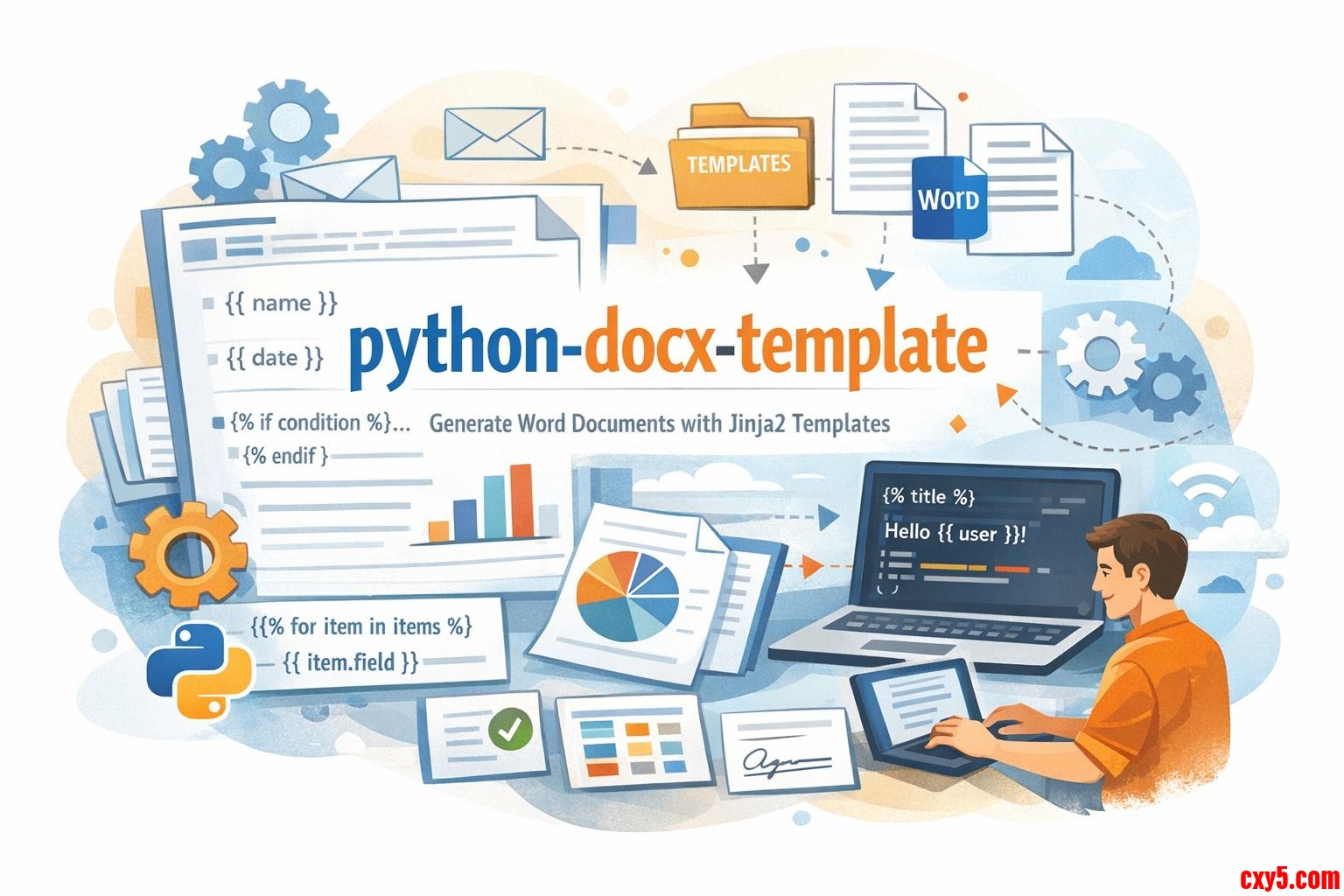
python-docx-template正是为解决这一痛点而设计的。它借鉴Jinja2模板引擎的思路,允许在Word文档中直接插入类似{{variable}}的占位符,随后仅用几行代码即可完成数据填充,无需关心底层文档结构,完美适配基于模板修改文档的场景。
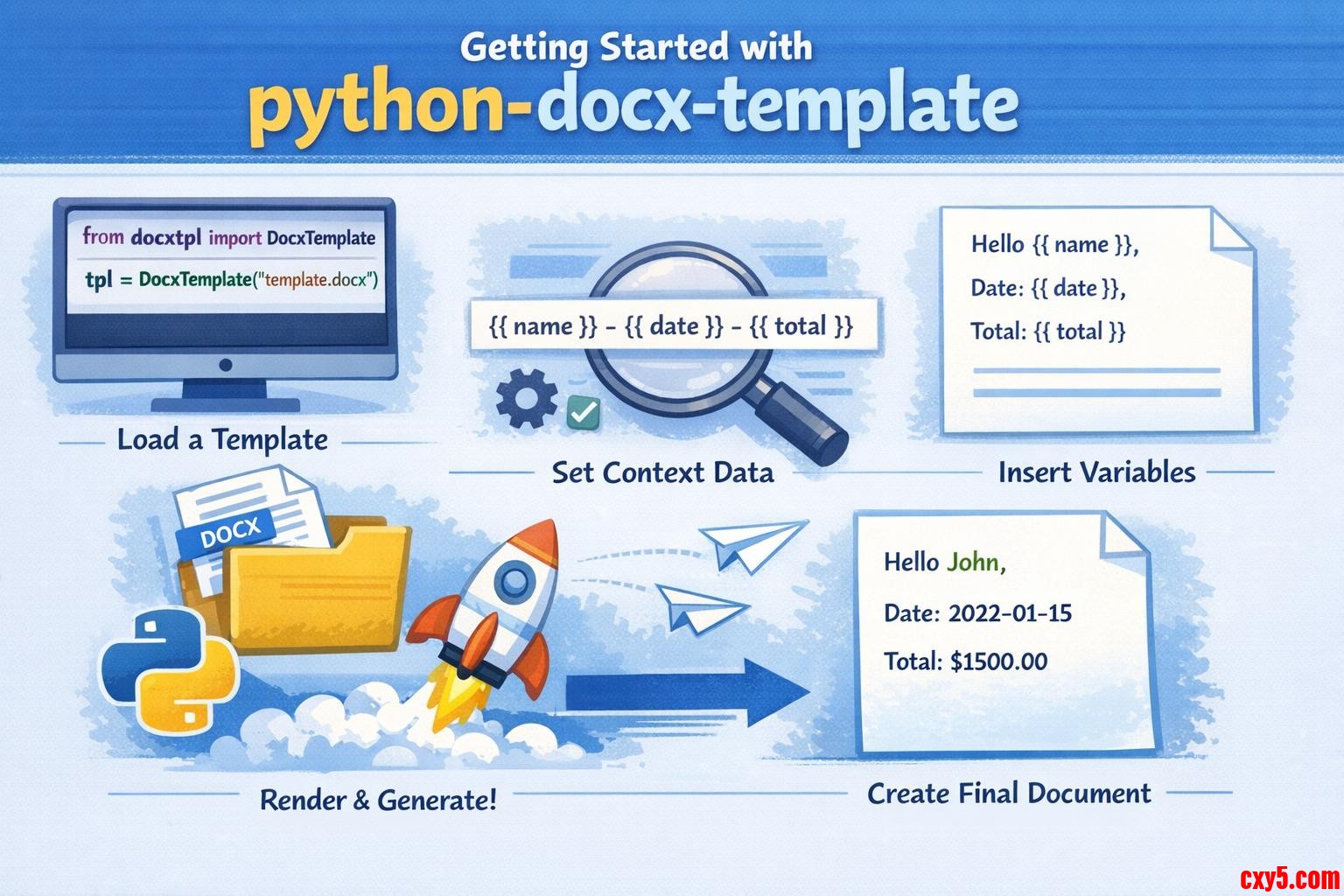
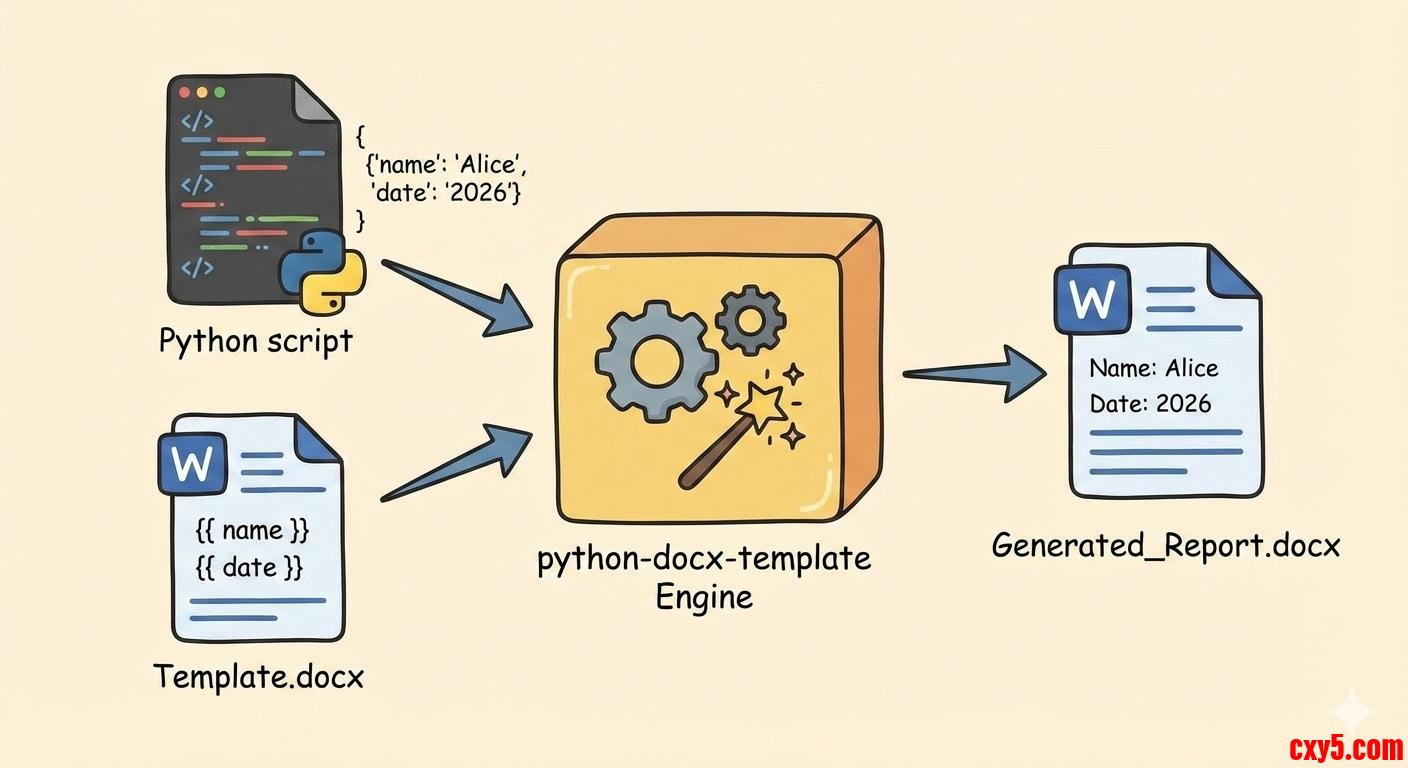
python-docx-template基于python-docx实现文档读写功能,并借助jinja2提供灵活的模板标签支持,其设计思路如下:
- 用Word制作模板
在Microsoft Word中自由设计文档格式,如插入图片、设置页眉页脚、调整表格样式,充分利用Word强大的排版功能。
- 插入模板变量
在需要动态内容的位置,直接输入Jinja2风格的标签,例如{{company_name}}或{%for item in list%}。
- 保存为模板文件
将文档保存为普通的.docx文件,该文件即成为可复用的模板。
- 用Python批量生成
加载模板并传入字典或对象,python-docx-template会自动替换标签,生成最终文档。
python-docx-template的官方代码仓库地址为:python-docx-template,详细文档可参阅:python-docx-template doc。本文使用的python-docx-template版本为0.20.2,安装命令如下:
pip install docxtpl
其中,docxtpl是python-docx-template库的正式分发名称,二者指代同一工具。
目录
- 1 使用说明
- 1.1 核心概念
- 1.2 复杂元素
- 1.2.1 富文本
- 1.2.2 富文本段落
- 1.2.3 浮动对象
- 1.2.4 子文档
- 1.3 补充操作
- 1.3.1 转义操作
- 1.3.2 获取未定义变量
- 1.3.3 Jinja自定义过滤器
- 1.3.4 Microsoft Word 2016特殊行为说明
- 2 参考
1 使用说明
1.1 核心概念
1.1.1 标签说明
python-docx-template允许在Word文档中使用Jinja2标签和过滤器。但为确保其在Word中正常运作,需遵循若干限制。
常规Jinja2标签仅能在同一段落内且同一文本运行中使用,若需控制段落、表格行或包含样式的完整文本运行,则必须使用后续章节介绍的复杂元素标签语法。
举例而言,若创建一个所有字符样式相同的段落,Word内部只会生成一个文本运行对象。但若在该段落中将部分文字设置为加粗,Word会将原有文本运行拆分为三个独立部分,分别对应普通样式、加粗样式及恢复后的普通样式。
标签
若要对段落、表格行、表格列以及文本段进行管理,需使用以下专用语法:
- 段落标签:{%p jinja2_tag %}
- 表格行标签:{%tr jinja2_tag %}
- 表格列标签:{%tc jinja2_tag %}
- 文本段标签:{%r jinja2_tag %}
这些以{% %}包裹的内容是Jinja2模板语法标签,引擎会识别并执行其中的逻辑。一个完整的模板标签基本结构如下:- {% 指令关键字 参数/条件 %} // 起始标签
- 内容 // 被标签控制的文本
- {% 结束关键字 %} // 结束标签
假设模板内容如下:- {%p if display_paragraph %}
- 一段或多段文本内容
- {%p endif %}
只有当display_paragraph的值为True时,以下内容才会被保留在生成的文档里:对于模板里的标签格式需遵循如下要求,否则无法生成正确结果:
- 起始标签分隔符后必须加空格,结束标签分隔符前必须加空格:
- 错误示例:
- {%if something%}
- {%pif display_paragraph%}
- 正确示例:
- {% if something %}
- {%p if display_paragraph %}
- 同一段落、行、列或文本段内,禁止连续使用标签分隔符:
- 标签与内容不可写在同一行,需换行排版:
- 错误示例:
- {%p if display_paragraph %}Here is my paragraph {%p endif %}
- 正确示例:
- {%p if display_paragraph %}
- Here is my paragraph
- {%p endif %}
1.1.2 常见元素
显示变量
Jinja2模板里,可以用双大括号来显示变量:如果变量是普通字符串,字符串里的特殊符号会自动转换成对应的格式:
- \n → 换行
- \a → 分段
- \t → 制表符(按一下 Tab 键的效果)
- \f → 分页符
如果变量是富文本(RichText)对象,必须在变量名前加一个r,明确表示要渲染这个富文本内容:注意,r要紧跟在左大括号的后面。
此外,变量名中禁止直接使用, &这类字符,除非用了转义语法。
注释
可以在模板中添加类Jinja2风格的注释,注释不会被渲染到最终文件:- {#p 这是一个段落类型的注释 #}
- {#tr 这是一个表格行类型的注释 #}
- {#tc 这是一个表格单元格类型的注释 #}
- # https://github.com/elapouya/python-docx-template/blob/master/tests/comments.py
- from docxtpl import DocxTemplate
- import os
- # data: https://github.com/elapouya/python-docx-template/blob/master/tests/templates/comments_tpl.docx
- tpl = DocxTemplate("templates/comments_tpl.docx")
- tpl.render({})
- os.makedirs("output",exist_ok=True)
- tpl.save("output/comments.docx")
若包含Jinja2标签的文本过长,会导致可读性下降,例如:- 我的房子位于{% if living_in_town %}城市区域{% else %}乡村地区{% endif %},我非常喜欢它。
- 我的房子位于
- {%- if living_in_town -%}
- 城市区域
- {%- else -%}
- 乡村地区
- {%- endif -%}
- ,我非常喜欢它。
- from docxtpl import DocxTemplate
- tpl = DocxTemplate("template.docx")
- context = {"living_in_town": True}
- tpl.render(context)
- tpl.save("output/output.docx")
可以使用colspan标签实现表格单元格的水平合并:必须为整数,用于指定需要合并的列数。也可通过Jinja2模板引擎自动计算,如内置过滤器count通过管道符|接收col_labels,用于统计其元素数量:- {% colspan col_labels|count %}
- # https://github.com/elapouya/python-docx-template/blob/master/tests/dynamic_table.py
- from docxtpl import DocxTemplate
- import os
- # data: https://github.com/elapouya/python-docx-template/blob/master/tests/templates/dynamic_table_tpl.docx
- tpl = DocxTemplate("templates/dynamic_table_tpl.docx")
- context = {
- "col_labels": ["fruit", "vegetable", "stone", "thing"],
- "tbl_contents": [
- {"label": "yellow", "cols": ["banana", "capsicum", "pyrite", "taxi"]},
- {"label": "red", "cols": ["apple", "tomato", "cinnabar", "doubledecker"]},
- {"label": "green", "cols": ["guava", "cucumber", "aventurine", "card"]},
- ],
- }
- tpl.render(context)
- os.makedirs("output",exist_ok=True)
- tpl.save("output/dynamic_table.docx")
- # https://github.com/elapouya/python-docx-template/blob/master/tests/horizontal_merge.py
- from docxtpl import DocxTemplate
- import os
- # data: https://github.com/elapouya/python-docx-template/blob/master/tests/templates/horizontal_merge_tpl.docx
- tpl = DocxTemplate("templates/horizontal_merge_tpl.docx")
- tpl.render({})
- os.makedirs("output",exist_ok=True)
- tpl.save("output/horizontal_merge.docx")
- # https://github.com/elapouya/python-docx-template/blob/master/tests/vertical_merge.py
- from docxtpl import DocxTemplate
- # data: https://github.com/elapouya/python-docx-template/blob/master/tests/templates/vertical_merge_tpl.docx
- tpl = DocxTemplate("templates/vertical_merge_tpl.docx")
- context = {
- "items": [
- {"desc": "Python interpreters", "qty": 2, "price": "FREE"},
- {"desc": "Django projects", "qty": 5403, "price": "FREE"},
- {"desc": "Guido", "qty": 1, "price": "100,000,000.00"},
- ],
- "total_price": "100,000,000.00",
- "category": "Book",
- }
- tpl.render(context)
- tpl.save("output/vertical_merge.docx")
1.2 复杂元素
1.2.1 富文本
富文本(Rich Text)是相对于纯文本(Plain Text)而言的一种文本格式。它不仅包含文字内容,还支持为文字添加各种格式属性及多媒体元素,从而呈现出更为丰富的视觉效果。这种格式的编辑和处理也可以通过在Microsoft Word软件中预先定义字符样式来实现。
在python-docx-template中使用富文本的步骤如下:
- 在Word模板中,为富文本定义一个占位符。例如,使用{{r rich_text_var}},其中的r表示富文本。
- 在Python代码中,利用RichText类构建带有格式的文本内容。
- 渲染模板时,占位符会被替换为富文本内容,并保留所有已定义的格式样式。
在代码中使用RichText类时,还可通过以下标记控制文本格式:
以下为生成富文本Word文档的示例:- # https://github.com/elapouya/python-docx-template/blob/master/tests/richtext.py
- from docxtpl import DocxTemplate, RichText
- # data: https://github.com/elapouya/python-docx-template/blob/master/tests/templates/richtext_tpl.docx
- tpl = DocxTemplate("templates/richtext_tpl.docx")
- rt = RichText()
- # 向富文本对象中添加内容,依次演示不同的文本格式设置
- rt.add("a rich text", ) # 使用自定义样式
- rt.add(" with ")
- rt.add("some italic", italic=True) # 斜体文本
- rt.add(" and ")
- rt.add("some violet", color="#ff00ff") # 紫色文本(十六进制颜色码)
- rt.add(" and ")
- rt.add("some striked", strike=True) # 删除线文本
- rt.add(" and ")
- rt.add("some Highlighted", highlight="#ffff00") # 黄色高亮文本
- rt.add(" and ")
- rt.add("some small", size=14) # 小字号文本(14磅)
- rt.add(" or ")
- rt.add("big", size=60) # 大字号文本(60磅)
- rt.add(" text.")
- rt.add("\nYou can add an hyperlink, here to ")
- # 添加带超链接的文本,build_url_id 用于创建URL标识并关联到指定链接
- rt.add("bing", url_id=tpl.build_url_id("http://bing.com"))
- rt.add("\nEt voilà ! ")
- # 演示换行符效果
- rt.add("\n1st line")
- rt.add("\n2nd line")
- rt.add("\n3rd line")
- # \a 用于创建新段落
- rt.add("\aA new paragraph : <cool>\a")
- # \f 用于插入分页符
- rt.add("--- A page break here (see next page) ---\f")
- # 循环演示不同类型的下划线样式
- for ul in [
- "single", # 单下划线
- "double", # 双下划线
- "thick", # 粗下划线
- "dotted", # 点下划线
- "dash", # 短划线下划线
- "dotDash", # 点划线下划线
- "dotDotDash", # 双点划线下划线
- "wave", # 波浪线下划线
- ]:
- rt.add("\nUnderline : " + ul + " \n", underline=ul)
- # 演示不同字体的设置
- rt.add("\nFonts :\n", underline=True)
- rt.add("Arial\n", font="Arial")
- rt.add("Courier New\n", font="Courier New")
- rt.add("Times New Roman\n", font="Times New Roman")
- # 演示上标和下标文本
- rt.add("\n\nHere some")
- rt.add("superscript", superscript=True) # 上标文本
- rt.add(" and some")
- rt.add("subscript", subscript=True) # 下标文本
- # 创建一个新的富文本对象,并将之前创建的rt对象嵌入其中,实现富文本嵌套
- rt_embedded = RichText("an example of ")
- rt_embedded.add(rt)
- # 构建渲染上下文,将嵌套的富文本对象赋值给模板中的 "example" 变量
- context = {
- "example": rt_embedded,
- }
- # 将上下文数据渲染到Word模板中
- tpl.render(context)
- # 保存渲染后的Word文档到指定路径
- tpl.save("output/richtext.docx")
若要精细控制单个段落的样式,可在代码中使用RichTextParagraph()或RP()对象。此对象需通过{{p }}语法添加至模板。示例代码如下:- # https://github.com/elapouya/python-docx-template/blob/master/tests/richtextparagraph.py
- from docxtpl import DocxTemplate, RichText, RichTextParagraph
- # data: https://github.com/elapouya/python-docx-template/blob/master/tests/templates/richtext_paragraph_tpl.docx
- tpl = DocxTemplate("templates/richtext_paragraph_tpl.docx")
- # 创建富文本段落对象组合不同样式的段落
- rtp = RichTextParagraph()
- # 创建富文本对象,用于设置文本的字符样式
- rt = RichText()
- # 向富文本段落中添加文本,并指定自定义样式myrichparastyle
- rtp.add(
- "The rich text paragraph function allows paragraph styles to be added to text",
- para,
- )
- # 添加文本并使用内置段落样式IntenseQuote
- rtp.add("Any built in paragraph style can be used", para)
- # 添加文本并使用自定义样式createdStyle
- rtp.add(
- "or you can add your own, unlocking all style options", para
- )
- # 添加文本并使用默认普通段落样式normal
- rtp.add(
- "To use, just create a style in your template word doc with the formatting you want "
- "and call it in the code.",
- para,
- )
- # 演示不同列表样式的使用
- rtp.add("This allows for the use of")
- rtp.add("custom bullet\apoints", para) # 方形项目符号样式
- rtp.add("Numbered Bullet Points", para) # 数字编号样式
- rtp.add("and Alpha Bullet Points.", para) # 字母编号样式
- # 演示文本对齐方式的设置
- rtp.add("You can", para) # 默认左对齐
- rtp.add("set the", para) # 应用自定义样式居中对齐
- rtp.add("text alignment", para) # 应用自定义样式右对齐
- # 演示行间距样式:紧凑行间距
- rtp.add(
- "as well as the spacing between lines of text. Like this for example, "
- "this text has very tight spacing between the lines.\aIt also has no space between "
- "paragraphs of the same style.",
- para,
- )
- # 演示行间距样式:宽行间距
- rtp.add(
- "Unlike this one, which has extra large spacing between lines for when you want to "
- "space things out a bit or just write a little less.",
- para,
- )
- # 演示段落背景色样式:绿色背景
- rtp.add(
- "You can also set the background colour of a line.", para
- )
- # 构建富文本字符串,演示字符级样式
- rt.add("This works with ")
- rt.add("Rich ", bold=True) # 加粗
- rt.add("Text ", italic=True) # 斜体
- rt.add("Strings", underline="single") # 单下划线
- rt.add(" too.")
- # 将富文本对象添加到富文本段落中,并指定方形项目符号样式
- rtp.add(rt, para)
- # 构建渲染上下文,将富文本段落对象绑定到模板中的example变量
- context = {
- "example": rtp,
- }
- # 将上下文数据渲染到 Word 模板中
- tpl.render(context)
- # 保存渲染后的 Word 文档到指定路径
- tpl.save("output/richtext_paragraph.docx")
图片插入
可在文档中动态插入单张或多张图片,当前已支持JPEG和PNG格式。只需在模板中使用{{ <变量名> }}格式的标签即可。图片嵌入代码如下:- myimage = InlineImage(tpl, image_descriptor='test_files/python_logo.png', width=Mm(20), height=Mm(10))
- # https://github.com/elapouya/python-docx-template/blob/master/tests/inline_image.py
- from docxtpl import DocxTemplate, InlineImage
- from docx.shared import Mm
- import jinja2
- # data: https://github.com/elapouya/python-docx-template/blob/master/tests/templates/inline_image_tpl.docx
- tpl = DocxTemplate("templates/inline_image_tpl.docx")
- # 定义渲染模板所需的上下文数据
- context = {
- # 只设置宽或者高,则图片自适应变化
- "myimage": InlineImage(tpl, "templates/python_logo.png", width=Mm(20)),
- # 手动指定宽高度
- "myimageratio": InlineImage(
- tpl, "templates/python_jpeg.jpg", width=Mm(30), height=Mm(60)
- ),
- # 定义图片+描述
- "frameworks": [
- {
- "image": InlineImage(tpl, "templates/django.png", height=Mm(10)),
- "desc": "The web framework for perfectionists with deadlines",
- },
- {
- "image": InlineImage(tpl, "templates/zope.png", height=Mm(10)),
- "desc": "Zope is a leading Open Source Application Server "
- "and Content Management Framework",
- },
- {
- "image": InlineImage(tpl, "templates/pyramid.png", height=Mm(10)),
- "desc": "Pyramid is a lightweight Python web framework aimed at taking "
- "small web apps into big web apps.",
- },
- {
- "image": InlineImage(tpl, "templates/bottle.png", height=Mm(10)),
- "desc": "Bottle is a fast, simple and lightweight WSGI micro web-framework "
- "for Python",
- },
- {
- "image": InlineImage(tpl, "templates/tornado.png", height=Mm(10)),
- "desc": "Tornado is a Python web framework and asynchronous networking "
- "library.",
- },
- ],
- }
- # autoescape是否开启自动转义,把模板变量中的特殊字符转换成无害的HTM实体
- jinja_env = jinja2.Environment(autoescape=True)
- # 使用上下文数据和自定义的jinja2环境渲染Word模板
- tpl.render(context, jinja_env)
- tpl.save("output/inline_image.docx")
可对文档中的现有图片进行替换,具体操作如下:先在模板中插入一张占位图,按常规流程渲染模板,之后再将占位图替换为目标图片。该方法支持批量处理文档内的所有媒体文件,且替换后的图片将维持原占位图的纵横比。在模板中插入图片时,只需指定文件名即可。该替换操作同时对页眉、页脚及正文区域生效。
例如,替换占位图dummy_header_pic.jpg的语法示例如下:- tpl.replace_pic('dummy_header_pic.jpg', 'header_pic_i_want.jpg')
在找到目标图片对应的pic:nvPicPr节点后,其name属性的值即为图片在文档中实际存储的文件名。此处的文件名可能不包含图片格式后缀,替换图片的示例代码可能如下:- tpl.replace_pic('Picture 1','header_pic_i_want.jpg')
模板变量可包含复杂的子文档对象,且能通过python-docx的文档操作方法从零构建。具体步骤为:先从模板对象中获取子文档对象,再将其当作python-docx文档对象使用。该功能需要安装额外依赖:
pip install "docxtpl[subdoc]"
以下代码展示了如何创建子文档,并将该子文档嵌入到主模板中,最终生成并保存新的文档:- # https://github.com/elapouya/python-docx-template/blob/master/tests/subdoc.py
- from docxtpl import DocxTemplate
- from docx.shared import Inches
- # data: https://github.com/elapouya/python-docx-template/blob/master/tests/templates/subdoc_tpl.docx
- # 1. 加载Word模板文件(指定模板文件路径)
- tpl = DocxTemplate("templates/subdoc_tpl.docx")
- # 2. 创建一个新的子文档对象
- sd = tpl.new_subdoc()
- # 3. 向下文档中添加段落内容
- p = sd.add_paragraph("This is a sub-document inserted into a bigger one")
- p = sd.add_paragraph("It has been ")
- # 为文本片段设置自定义样式
- p.add_run("dynamically").style = "dynamic"
- p.add_run(" generated with python by using ")
- # 为文本片段设置斜体样式
- p.add_run("python-docx").italic = True
- p.add_run(" library")
- # 4. 向下文档添加标题
- sd.add_heading("Heading, level 1", level=1)
- # 向下文档添加带样式的段落(IntenseQuote样式为内置样式)
- sd.add_paragraph("This is an Intense quote", )
- # 5. 向下文档插入图片
- sd.add_paragraph("A picture :")
- sd.add_picture("templates/python_logo.png", width=Inches(1.25))
- # 6. 向下文档插入表格
- sd.add_paragraph("A Table :")
- # 创建表格(初始1行3列,作为表头)
- table = sd.add_table(rows=1, cols=3)
- # 获取表头单元格并设置内容
- hdr_cells = table.rows[0].cells
- hdr_cells[0].text = "Qty"
- hdr_cells[1].text = "Id"
- hdr_cells[2].text = "Desc"
- # 定义表格数据
- recordset = ((1, 101, "Spam"), (2, 42, "Eggs"), (3, 631, "Spam,spam, eggs, and ham"))
- # 循环添加数据行到表格
- for item in recordset:
- row_cells = table.add_row().cells
- row_cells[0].text = str(item[0]) # 数量(转为字符串)
- row_cells[1].text = str(item[1]) # ID(转为字符串)
- row_cells[2].text = item[2] # 描述
- context = {
- "mysubdoc": sd,
- }
- tpl.render(context)
- tpl.save("output/subdoc.docx")
- # https://github.com/elapouya/python-docx-template/blob/master/tests/merge_docx.py
- from docxtpl import DocxTemplate
- # data: https://github.com/elapouya/python-docx-template/blob/master/tests/templates
- tpl = DocxTemplate("templates/merge_docx_master_tpl.docx")
- sd = tpl.new_subdoc("templates/merge_docx_subdoc.docx")
- context = {
- "mysubdoc": sd,
- }
- tpl.render(context)
- tpl.save("output/merge_docx.docx")
1.3.1 转义操作
默认情况下,python-docx-template不会对内容进行转义。这是因为在使用模板语法修改Word文档时,底层实际上是在处理XML结构,而像 和&这样的字符在XML中具有特殊含义,必须经过转义才能正确显示。以下提供几种实现转义的方法:
- 上下文定义时使用R()包裹内容,模板中添加r标记:
- context = { 'var': R('my text') }
- 上下文保持原始字符串,模板中使用|e过滤器:
- context = { 'var':'my text' }
- 上下文使用escape()函数处理内容,模板直接引用:
- context = { 'var': escape('my text') }
- 调用render方法时启用自动转义,默认值为autoescape=False:
- tpl.render(context, autoescape=True)
在文档中插入代码清单时,如果需要同时转义文本并处理换行符(\n)、段落符(\a)和换页符(\f),可以在Python代码中使用Listing类。
例如:- context = {
- 'mylisting': Listing('the listing\nwith\nsome\nlines \a and some paragraph \a and special chars : <>&')
- }
使用示例如下:
[code]# https://github.com/elapouya/python-docx-template/blob/master/tests/escape.pyfrom docxtpl import DocxTemplate, R, Listing# data: https://github.com/elapouya/python-docx-template/blob/master/tests/templates/escape_tpl.docxtpl = DocxTemplate("templates/escape_tpl.docx")context = { "myvar": R( '"less than" must be escaped : |



 提升卡
提升卡 置顶卡
置顶卡 沉默卡
沉默卡 喧嚣卡
喧嚣卡 变色卡
变色卡 千斤顶
千斤顶 照妖镜
照妖镜